
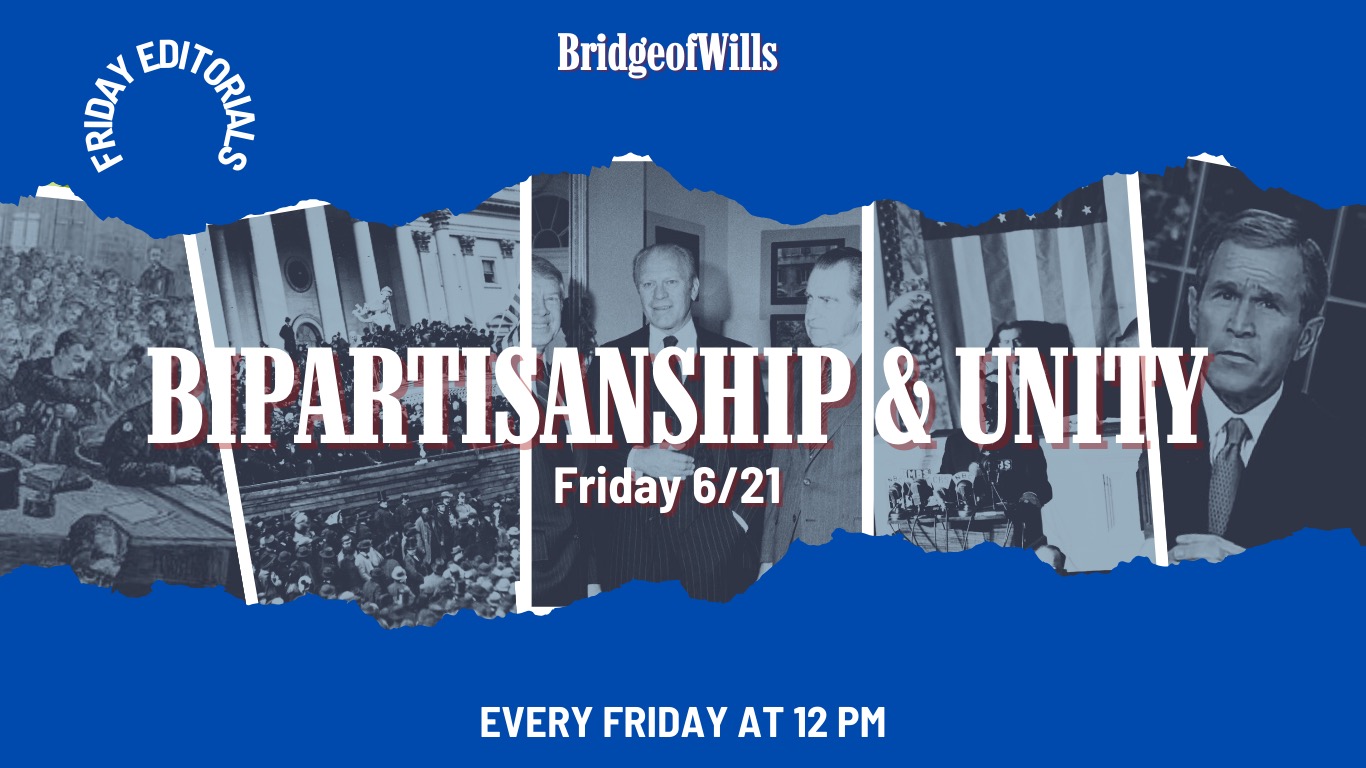
This special article is an effort between both myself and Felix and I was tasked with writing an intro to it, so I’ll give it my best. In America, we’re seeing both sides rip each other apart mercilessly as they seek to advance party goals, not country goals. We’re seeing radical extremists try to hijack the levers of power by using a brand of demagoguery seen in totalitarian countries; our legislative process has ground to a halt as the same partisan passions acted upon in the political arena have eroded what should be the fundamentally nonpartisan act of governing: this has got to end. Our country has always been the greatest in history when we’ve thrown down the bitter language of partisan rhetoric for a hand of conciliation and unity. America has been built together and united. Now, with an election season that’ll see even harsher tactics and language than the one before, Felix and I have banded together to remind America of what makes her unique: unity in her history.
George Washington
If there is any single event that represents when America came together for the first time, it would be well after the Revolutionary War ended in 1783—the new nation was nearly a third of British Loyalists—and instead, in 1788, during America’s first-ever Presidential election. Following a tumultuous period under the nation’s first rule of law, the Articles of Confederacy, the Constitution was created as a treatment for the issues under the aforementioned document. In this Constitution came the provision of the role of the Chief Executive, the President of the United States of America. The election of 1788 would determine the first ever President of the United States, and thus, it was vied after by many. Yet despite 12 candidates running, only one had unanimous support from the people: George Washington. Washington himself had been reluctant to assume the role of President, meaning that his election is commonly considered a grassroots campaign to get him to run. Once all states had chosen their electors, the results came in: Washington won 99.9% of the popular vote, and all 69 electors chose to elect George Washington.
Although it is nigh impossible for us ever to see a presidential candidate achieve 99.9% of the popular vote1 again, the election of 1788 serves as a reminder that America has stood proud before great leaders and can do so again.

Missouri Compromise
Although unity is best seen in a 99.9% vote for a president, unity can also be seen in other methods, namely the art of compromise. And what else but an act that has been titulized a compromise: the Missouri Compromise.
Following the acquisition of lands by the Louisiana Purchase, America was confronted with an existential issue: the expansion of slavery. Then Speaker of the House, Henry Clay, came up with a solution for the territory of Missouri achieving statehood: Missouri would become a slave state, yet slavery could not expand above the 36th parallel. This compromise, although expanding the abhorrent institution of slavery, nonetheless unified a nation that experienced sectional differences for over 30 years until the bloody lead-up to the Civil War. Oftentimes, compromise isn’t seen as the most unifying position as everyone is seemingly unhappy, yet it is this fact that makes compromise so unifying. Although, thankfully, America today does not have to debate over slavery, we still have many sectional and polarizing differences; thus, America could learn to use the art of compromise more often, just as it had been done back in 1820 in the statehood of Missouri2.

Pendleton Act
Few Americans know of 20th President James Garfield, and even fewer know about the Pendleton Act3. Yet, after the assassination of President Garfield in 1881 by a disgruntled man who wished to be on his cabinet shook the nation, America was unified in stopping it from ever happening again.
Charles Guiteau was a man who believed himself to be critical in the election of James Garfield. He felt that he should be rewarded through the “spoils system,” in which a President rewards those who helped him by offering cabinet positions. However, Garfield saw things differently, and when he didn’t offer a position to Guiteau, Guiteau took things into his own hands and assassinated Garfield in front of a crowd of reporters.
America was horrified and quickly passed the 1883 Pendleton Act by margins of 39 to 5 in the Senate and 155 to 46 in the House. This act eliminated the “Spoils System” and created necessary proof of competence for cabinet positions. Unfortunately it required the sudden death of a President to create necessary legislative change in America, but when this change happened, it was ushered in by the vast support of the American populace. Sometimes, it seems like nowadays is the same, where great tragedy is needed to usher in necessary change.

WW2
December 7th, 1941: a day that will forever live in the collective infamy of the United States. War had been raging within Europe since Hitler decided to invade Poland in 1940. President Franklin Delano Roosevelt attempted to tow a delicate line by aiding Britain, the last bastion of freedom on the European continent, through the Lend-Lease Act4. But on December 7th, after the death of almost 3,000 of our soldiers, America joined hands and lent support to the President.
Regardless of party, America mobilized for the war effort, joining together to defeat the common threat of authoritarianism that had subjugated millions, and we persevered to ensure we weren’t one of the subjugated. When the threat of authoritarianism came knocking at our door, we listened and responded, and now, in an era where it seems the cold shadow of authoritarianism has begun to creep up again, we need to come together as our ancestors did and emphatically reject its allure. We can’t ever forget the sacrifice of 500,000 of our boys for the cause of protecting our liberties at home: the lesson learned, regardless of party, the inherent liberties we enjoy as Americans must be cherished equally by all of us, and when they are under threat: we unite and rise as we have before and say no.

Humphrey’s Gift
The dying statesman Hubert Horatio Humphrey lay dying in his frozen-over Minnesota home from a cancer that rendered the happy warrior bedridden, knowing his time was short. On the other side of the country, disgraced and depressed former President Richard Nixon wallowed as everything had seemed to slip away from him; Nixon had lost control of his Presidency in the Watergate scandal and control of his legacy. President Nixon had been cast away from Washington, but the happy warrior was determined to leave him a parting gift: Humphrey officially asked Nixon to attend the funeral with the full honors of a former President, and if anyone protested his presence, Nixon was to respond he was there at the direct request of Humphrey. In death, Humphrey gave the man who handed him his bitterest political defeat during the 1968 election a chance to start rehabilitating his legacy. Humphrey laid down any residual prejudices and negative feelings he might’ve had towards Nixon from the 1968 election to give him a true and lasting gift.
We can learn from Hubert Humphrey’s attitude toward his bitterest political rival: if the bitterest of political rivals could reconcile during this moment, we can, too. No political disagreement is big enough to erase the kinship that exists between us because of the bond of citizenship. For Humphrey, in his last moments, politics was secondary, and his country was first5.

9/11
September 11th was a day just like any other, beginning as a bright, typical day where the rays of the sunshine reflected upon the ever-rising New York skyline would give way to an ash-filled inferno that would destroy the innocence of an era and scar a nation forever. One plane hit, then another, then another: a series of unrelenting tragedies as thousands were condemned to a terrible fate. Time passed, and September 12th was quiet, with nothing of the cries and explosion of the day before; it was a country in mourning. A country mourning the loss of thousands and the loss of its innocence, but then the true spirit of America revealed itself. There was no partisan bickering or finger-pointing at President Bush or at each other, but there was a kinship that revealed itself in America’s grief. Millions embraced each other, not knowing who the other was, without regard to color, race, or creed; all that remained in the rubble of an unimaginable tragedy was a nation grief-stricken but not destroyed. A nation united behind finding those responsible and ensuring that the thousands who died didn’t die in vain.
9/11 revealed who we were as a nation; it didn’t matter what party or political affiliation you had; there was only the American spirit.
That’s all that will ever remain: the American spirit. The American spirit binds and unites us; our country was built together and not apart. With politics getting more bitter and people becoming more divided, that’s a fact that people seem to deny. There are some in power that have a vested interest in a divided population only to seek personal gain. We, as a people, must never yield to appellations by self-serving politicians and demagogues who seek to bring out the worst in us but strive to bring out the best in one another. Why united? Because the best of America is always when she is united and that is and always will be an undeniable fact.
- https://www.whitehouse.gov/about-the-white-house/presidents/george-washington/ ↩︎
- https://www.archives.gov/milestone-documents/missouri-compromise ↩︎
- https://www.archives.gov/milestone-documents/pendleton-act ↩︎
- https://www.archives.gov/milestone-documents/lend-lease-act#:~:text=Passed%20on%20March%2011%2C%201941,defense%20of%20the%20United%20States.%22 ↩︎
- https://richardnixonsocal.com/2023/09/richard-nixon-hubert-humphrey-a-lasting-friendship/ ↩︎


Leave a Reply