
Surely you must have heard this story before: some hapless individual happens to get unlucky and injured, but no biggie, our modern medicine can cure them just as quickly. This is, of course, the dream. But for many, the situation is not so simple. Their insult to injury is that they get slapped with a mammoth bill, as large and callous as an evil giant. In fact, the only difference between the two is while giants are myths, the shadow of debt is much too real. However, both have wormed themselves into America’s canon, especially for the lower class for whom even small debt may be crushing. This is the natural consequence of America’s natural selection in its healthcare system (or lack thereof). You have it, or you’re screwed. People with less wealth best not get hurt, or else they might face the choice of life versus livelihood. This system, in all honesty, is not very good. There is no reason why the Hippocratic Oath should come with a rider. Even if you work a job, there is no guarantee that you can pay the doctors when you break your foot, God forbid, or even worse. When the system meant to support hard-working citizens is absent at best in times of crisis, then change must be needed.
This change, I believe, should come in the form of some sort of universal healthcare. More of the government’s money should be spent on helping its own people, and the vital system of hospitals and doctors needs the biggest budget increase. And if a tax increase could not be passed to account for this, then at least efforts could be made to move some of the military’s quite extreme budget to healthcare: ultimately, government money should be spent for the security and health of the people, and the military is disproportionally gifted in this effort (spending around and above $820 billion, according to the government’s own data on usaspending.gov). Of course, due to the aforementioned budgetary concerns, any system the government puts into place may not be completely optimal or refined; but a rudimentary system is still better than none, and each person would benefit all the same. Of course, without knowing the benefits, no one could calculate if universal healthcare would be useful, but researchers from Yale have already done so. To wit, universal healthcare probably would have saved over 200,000 lives in 2020 alone, and saved the country $105 billion in expenses, worth any cost.
Now, I think any system should still allow private healthcare firms to operate under heightened prices, too. The government should not be controlling all business, and if someone wants to charge whatever prices they want for whatever services they want, who am I to stop them? And, the option for more expensive, luxury healthcare would serve as a strong motivator to encourage the American people to strive for excellence, while cheaper government healthcare could help them to survive along the way. The system clearly works for schools, so why shouldn’t we give it a try in situations of life and death?
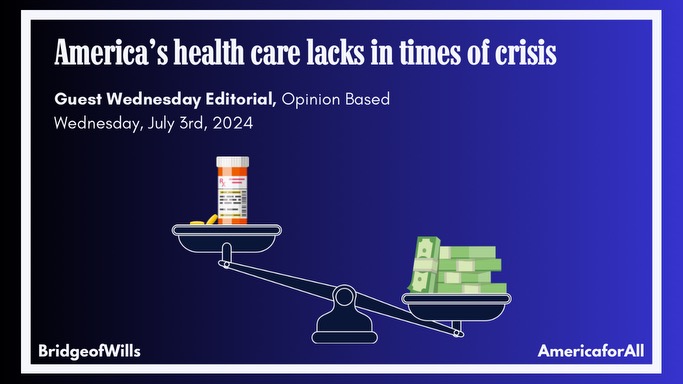
America’s health care lacks in times of crisis

Discover more from Bridge of Wills
Subscribe to get the latest posts sent to your email.
Leave a Reply