
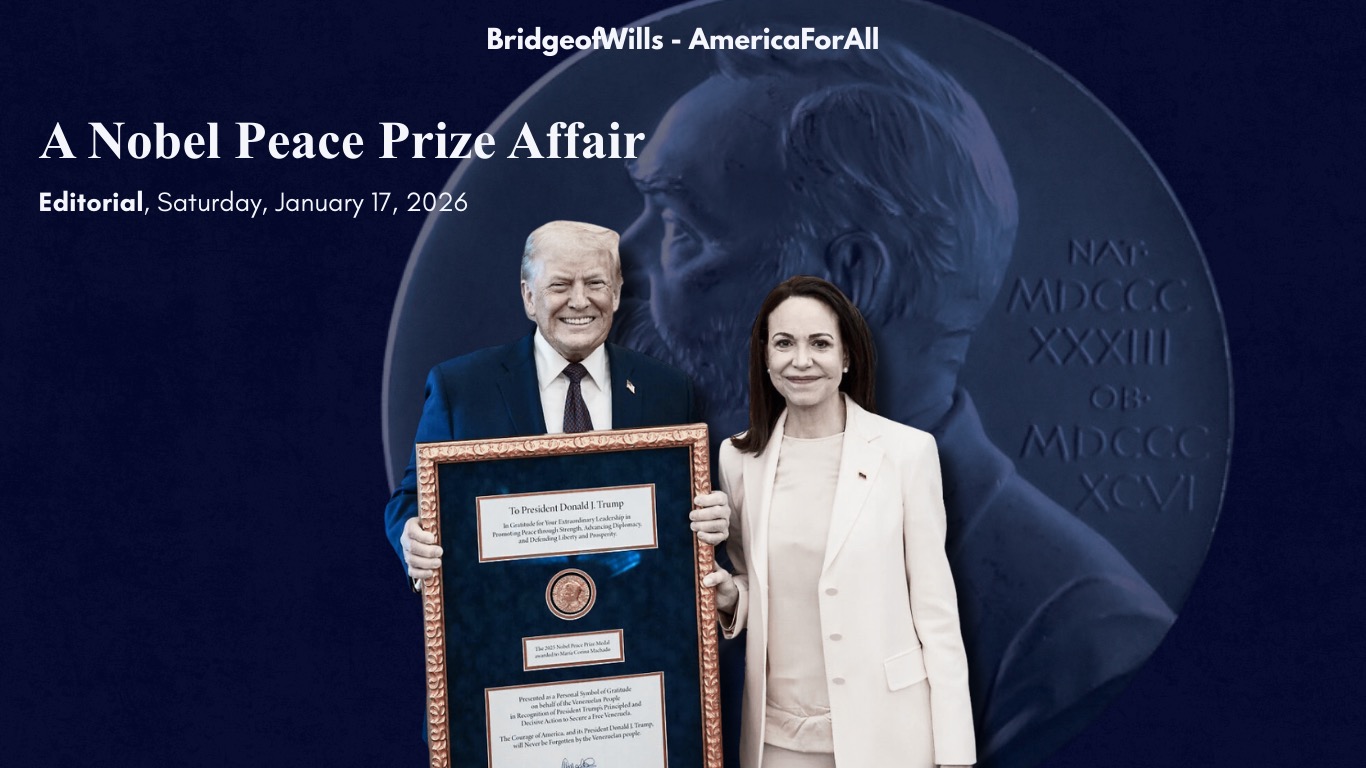
The Nobel Peace Prize, announced on the Friday of the first full week of October, has been the coveted prize for statesmen who, according to the prize’s namesake, “have done the most or the best work for fraternity between nations.” In the mind of the President of the United States, who claims to have settled eight wars in his first year as President, there is none more deserving of the prize than himself. The committee deemed otherwise. The award was instead granted to Venezuelan opposition leader Maria Corina Machado, who has led the fight to replace the Maduro regime and assert the democratic mandate of the Venezuelan people. President Trump promptly launched a tirade against the committee, feeling slighted that his efforts to win the prize had seemingly come to naught. Machado emerged as the victor for the prize, but a loser in the titanic power struggle against the remnants of the Maduro regime in a bid to decide Venezuela’s political destiny. The Venezuelan opposition leader has decided to turn the gambit on its head.
The July 2024 Elections
Venezuelans flooded the polls on July 28th, 2024, to select their next leader, and their next era. The opposition, represented by Edmundo Gonzalez, a former ambassador to Algeria and Argentina, but fronted by Maria Corina Machado, a woman who rose to prominence after her stint as a leader in the 2014 protests against the Nicholas Maduro regime. Despite surging across all metrics and clinching the title of opposition candidate on October 26th, 2023, Machado received a 15-year disqualification from office from the Supreme Tribunal of Justice. The court alleged her to be in cahoots with Juan Guaidó, who claimed the mantle of the presidency in 2019 under Article 233 of the Venezuelan Constitution by virtue of the “vacancy” of the Presidential seat passing to the President of the National Assembly. Guaidó was investigated on charges of embezzlement, violence, and rebellion: Machado was disbarred by association. In her stead, Gonzalez was selected as the opposition’s candidate.
After results flooded in, it became clear that Venezuela’s National Election Council (CNE) had tampered with the tally. Numbers provided by the opposition, compiled by thousands of poll workers across the country, confirmed a Gonzalez victory of over 67% of the vote, with Maduro receiving a mere 30%. The CNE’s totals came in 51% for Maduro and 44% for Gonzalez. What followed was a cascade of political repression that forced Gonzalez into exile in Spain, and Machado remained in the country, hidden, to avoid arrest. Their situation would remain strenuous until hope for the cause arose with the ascension of Donald Trump back into the Presidency and the appointment of fervent supporter Marco Rubio as Secretary of State.

Maduro’s Folly
“Peace, Peace, Peace. Do everything for peace. As John Lennon used to say, right?” Maduro then promptly broke out into song, singing Imagine by John Lennon to a crowd of supporters in Caracas on November 15th, 2025. Peace was the last thing on the mind of U.S. policy. In the weeks prior to this rally, a period of military proliferation that by August 29th, 2025, had brought seven U.S. warships, one nuclear-powered fast-attack submarine, and more than 4,500 sailors and Marines aboard various vessels. On September 2nd, Trump ordered the first strike on a Venezuelan boat he alleged was carrying “terrorists” who were members of Tren de Aragua, a transnational organized crime syndicate based in Venezuela.
Boat strikes continued, as the Republican Senate rubber-stamped the President’s actions, and the President stopped seeking authority from Congress altogether. Maduro, whose bounty had increased to $50 million dollars at the direction of the U.S. Attorney General for narcoterrorism, had days numbered. Machado sensed the imminent U.S. intervention and continued to make advances to carry President Trump’s favor, stating that Venezuela’s election rigging extended into tampering with U.S. elections. Playing upon President Trump’s belief that the 2020 U.S. election was “rigged” by outside actors via electronic voting.
Machado reemerged after more than a year of hiding on December 11th to receive the Nobel Prize in Oslo, Norway. In her acceptance speech, she dedicated the prize to Trump for his efforts in advancing the freedom of the Venezuelan people. Despite domestic heat over the boat strikes, all would come to a head when Maduro rejected an ultimatum in late December 2025 by the U.S. government to resign peacefully and go into exile in Turkey. In the advancing checkmate of international relations, Maduro took to the stage again and danced a dance reminiscent of Trump’s “YMCA” dance, a move Trump interpreted as a mockery of him, as shown by his remarks to Republican congressmen on January 6th, that dance move and the arrest of American citizens was a move too far. The decision was made to forcefully extract Maduro from power.

The Struggle and Absolute Resolve
Bad weather pushed Operation Absolute Resolve off for days, but on January 2nd, 2026, President Trump issued the final order to proceed at 10:46 P.M. Assets were moved into position, and more than 150 military aircraft, including fighter planes and bombers, would take part in the mission. U.S. forces began by temporarily disrupting Venezuelan military communications; this was followed by U.S. Special Operations entering Caracas. The plan did not go on without some complications. General Dan Caine would come to say that one aircraft was hit in the resulting counter fire by Venezuelan forces, but it remained flyable. In the resulting diversion, the U.S. Army Delta Force (one of the U.S. Army’s most elite units) entered Maduro’s compound and managed to capture Cilia Flores and Nicholas Maduro right before he was able to shut the door to his safe house, which would’ve made extraction much more difficult. As a whole, the operation would come to claim 100 Venezuelan lives according to Venezuela’s interior minister—this number has been disputed by the U.S.
President Trump would come to remark on Absolute Resolve that “If you would have seen what happened, I mean, I watched it literally like I was watching a television show. And if you would’ve seen the speed, the violence… it’s just, it was an amazing thing, an amazing job that these people did.” Across Venezuela, citizens cheered and the opposition declared that the hour of freedom had arrived. Excitement and hope turned sour quickly, as in a press conference late morning on January 3rd Trump stated that “I think it would be very tough for her to be the leader. She doesn’t have the support within or the respect within the country. She’s a very nice woman, but she doesn’t have the respect.” Maduro’s Vice-President and the rest of the administration would quickly consolidate power by arresting citizens celebrating the arrest of Maduro and celebrating U.S. involvement. President Trump has gone on to say of Delcy Rodríguez that she’s a “terrific” person and that she wouldn’t have any problems if the United States, in collaboration with oil companies, would develop the mass strategic reserves of oil in Venezuela. Machado and the opposition, left out in the cold, could do only one thing: appeal to the President’s hunger for the Peace Prize.

Machado’s Gambit
The President has not gotten over losing the prize in December, a prize awarded to Machado upon her nomination to the committee by Secretary of State Marco Rubio. Despite her assertion on national news circuits that the Nobel Prize was President Trump’s, the institute intervened by stating, “Once a Nobel Prize is announced, it cannot be revoked, shared, or transferred to others. The decision is final and stands for all time.” The Institute’s statement, however, didn’t mean the prize couldn’t be parted with at the recipient’s discretion. Historical examples include the former Secretary General Kofi Annan, who gave his Peace Prize to the United Nations’ Geneva Office in 2024. Machado moved to give the prize to the President of the United States.
In a meeting on January 15th, 2026 with Machado, Trump “received” the prize he had so long yearned for. The prize, adorned in an elaborately adorned plaque with an inscription reading “To President Donald J. Trump. In gratitude for your extraordinary leadership in promoting peace through strength, advancing diplomacy, and defending liberty and prosperity.” Machado elaborated that she had told President Trump, “Gen. Lafayette gave Simon Bolivar a medal with George Washington’s face on it. Bolivar kept that medal for the rest of his life.” Machado exited the White House with a Trump-signed gift bag and all smiles. Trump would rave about Machado being a “wonderful woman,” and thanked her on Truth Social for the prize. Time will tell if Machado’s gambit will trump Rodriguez’s.


Leave a Reply