
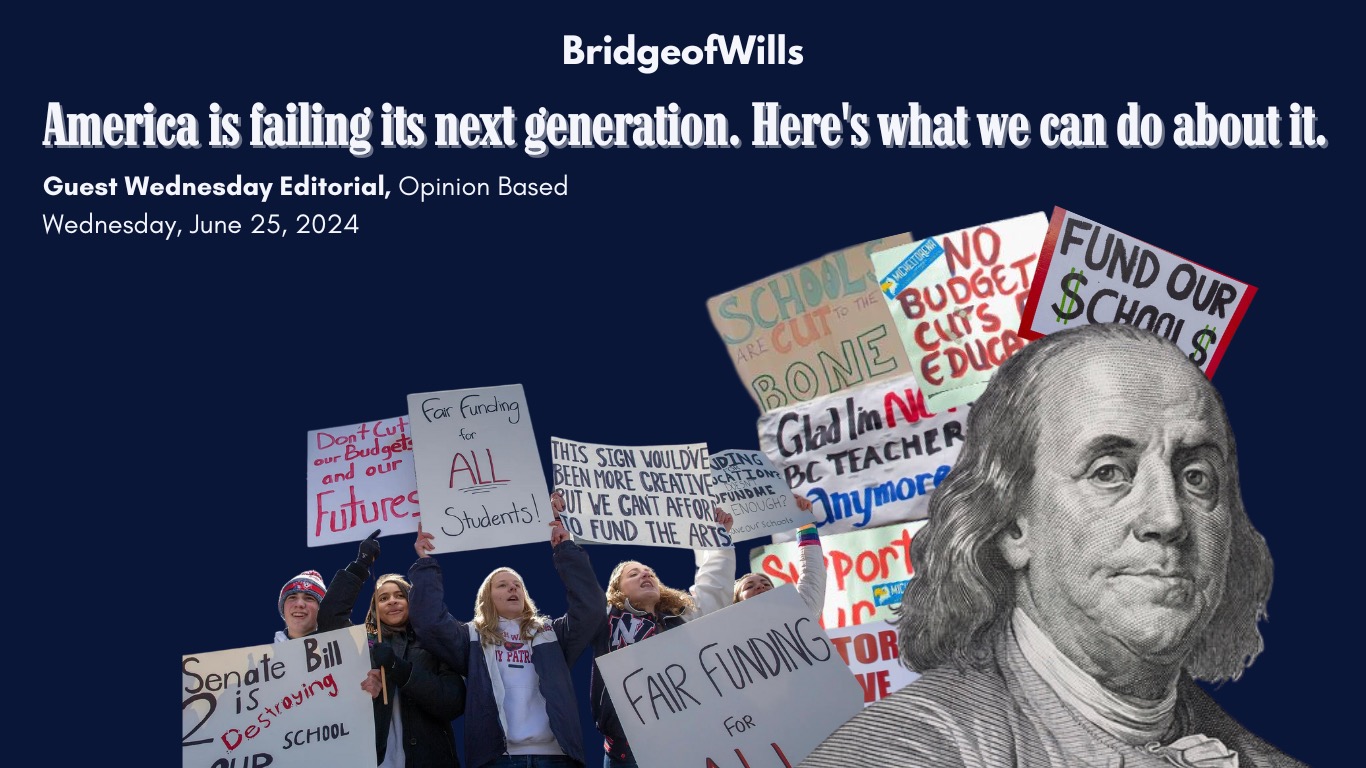
In 1787, just after Benjamin Franklin signed the U.S. Constitution, Elizabeth Willing Powel asked him, “Well, Doctor, what have we got, a republic or a monarchy?” Franklin famously answered, “A republic, if you can keep it.” Can we keep it, though?
A republic, if you can keep it
Ben Franklin
Failing Students
The first step in preserving a republic is to recognize that education serves as the cornerstone of its safeguarding. Our democracy is only so strong, as is the knowledge and commitment of its citizens. We simply cannot expect to have highly qualified candidates be elected to represent us when those who elect them lack the basic civic knowledge to make educated decisions as to whom to vote for.
Unfortunately, studies show that young Americans are extremely uninformed as to how our government works. A survey conducted by The Institute for Citizens & Scholars indicates that young adults, regardless of education level, lack basic civic knowledge, answering an average of only 1.6 questions correctly out of four standard civics questions; only 4% answered all four questions correctly. In Florida, of all the K-12 students who took the Florida Civic Literacy Examination in the 2021-2022 school year, only 37% passed. In Miami-Dade County, only 34% of students passed that same exam. The United States is in a civic literacy crisis.
The American people and its policymakers need to decide whether they want to step up and ensure our democratic values are secured for years to come or whether they want to kiss democracy goodbye and let our republic slowly drip down the drain until only an empty shell is left. We need a civic education revolution where we begin to prioritize experiential civic learning by directly involving students in our nation’s local, state, and federal governments. If we want an informed citizenry that goes out and actively participates in our country’s civic processes, we must teach civics the same way: with action. Civics is so much more than just a textbook subject; it’s a way of living that embodies active citizenship, engagement with one’s community, and a commitment to democratic principles.
If lawmakers care about civic education, not only do they need to fundamentally change the way civics is taught in the classroom, but they need to put their money where their mouth is. In 2019, Ted McConnell, the executive director of the Campaign for the Civic Mission of Schools, spoke up about the fact that the federal government spends $4 million a year on civics, compared to almost $3 billion a year on Science, Technology, Engineering, and Math education (STEM). While education is a matter that is left up to the states, federal funding rates reveal the overall level of importance our lawmakers give to civic education (or a lack thereof).
Mobilizing Education
Many different educational reforms can be made to improve civic literacy levels nationwide. For starters, we must remember that the best way to learn is by doing. Research suggests that cultivating active participation is key to proper civic education. Initiatives taken by states like Massachusetts, where the law requires that every high school provides at least one student-led, non-partisan civics project for each student to participate in, is a step in the right direction.
Another way to encourage young Americans to be active citizens is by directly involving them in our governmental processes. Many states, counties, and municipalities have started this process by establishing student positions on a series of government boards and committees, or by creating legislative youth advisory councils, youth advisory boards, youth activities committees, and many other similar initiatives. Many school boards also have a student school board member, student advisor, or student member of the board position through which the student voice can be officially heard, and a young adult is given the chance to be involved with government firsthand.
At Virtutem Populo, Inc., a student-led 501(c)(3) nonprofit organization dedicated to promoting civic engagement and community involvement among youth in Miami-Dade County, we have civically engaged over 2,500 students and spent over $40,000 towards unique civic education programs that work to increase civic literacy levels and engage young people in government. In March of 2024, we launched the Florida Student School Board Member Initiative, a statewide grassroots movement advocating for student representation on school boards across Florida. We are also in the process of organizing Miami-Dade County’s first Youth Governance Day: a day where high school students will have the chance to be mayor for the day of their municipality and experience how local government works from an inside perspective.
America has the oldest continuous democracy in the world, and it is up to us to keep it that way. We cannot let future generations be put in a position where uncivil discourse becomes the norm and polarization fueled by civic illiteracy grows more rampant than it already is today. The U.S. cannot afford the risk of sacrificing our Founding Fathers’ vision for our nation because we allowed the formation of an uninformed and unengaged electorate that has given up on America.
I’ll answer Benjamin Franklin’s point. We can keep our republic, but only if we make significant changes now before it is too late.


Leave a Reply