
A pertinent force of our national awareness on politics, especially for audiences forming their beliefs, is found at our closest convenience: our screens. A survey conducted by Pew Research Center suggests that an abundance of Americans rely on popular social media sites, ranging from Tiktok to Facebook, to satisfy their political digest, feeding on heavily partisan content that fundamentally cements their reservations on national politics and the role of voters. Furthermore, homogenized media has distorted accurate political representation via online partisan communities, where Americans engage with like-minded, entrenched, and territorialized beliefs on these platforms. Joining in on the national discussion, how can we mend the relationship between opinionated politics and noble news?
Insights from ‘Civil War’
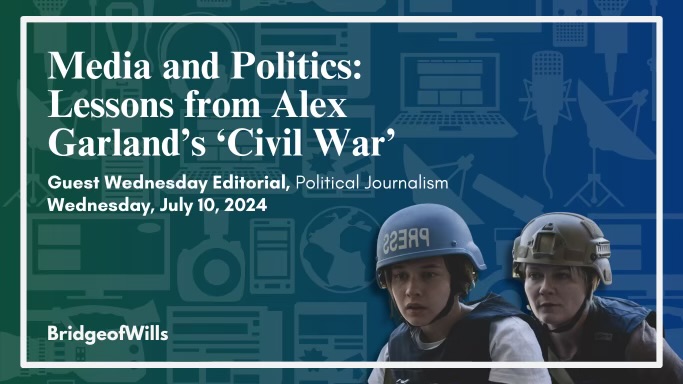
Brilliantly depicted in Alexander Garland’s ubiquitous 2024 thriller, Civil War, the film captures the effects of a dystopian U.S. government and dismembered society lacking the presence of democratized, humanitarian, and bi-partisan journalism. Portraying the U.S. at war with itself is not merely a rhetorical choice but a literal depiction, with each warring regional territory tearing each other to shreds over politically and socially extremist ideologies that suppress coverage on their domestic threat. The vivid project serves as a testament to the significant influences on U.S. political consciousness and the future of our civic participation following four domestic political journalists set against the tyrannical “democracy”, pushing news that garners divided audiences to realities of enduring a war-ridden America. Sticking true to themes that closely mirror our domestic reality, such as relentless bi-partisan discourse, social polarization and diffused falsehoods, Civil War presents these ideas as the disease known as utterly pervasive political disillusionment that afflicts even the most developed nations.

Safeguarding our Democracy: Ethical Journalism
The picture’s principle is key: to uphold the urgency to safeguard our democracy with honest and principled journalism. Meant to equip the public, professional journalists seek out and bravely provide real-world information as tools to defend cherished foundations of our democracy: free speech (especially press), and justice for all, keeping aforementioned dystopia as a mere fantasy. The film contrasts the idea of national journalism as a double-edged sword, with Americans using journalism to fight for democracy, and others to drape falsehoods under the pretense of security and truth. We’ve reached an obvious, yet unfortunate reality: in a grand match between politics and media, the latter runs the ringer.
Media is a powerful tool being used as a centrifugal force at large. It’s almost impossible to find ourselves avoiding misconstrued ideas during the process of rampant political polarization. Because the movement for media has the power to change our future, it is more important than ever to hold our national leaders and reporters in high regard, pushing the envelope for an outstanding and ethical press that doesn’t only “tell” our citizenry, but trains and serves it. As more information is spewed by the day, accountability and blatant transparency is crucial for maintaining a national camaraderie with reporters, utilizing our common man “online personalities” and diverse educational backgrounds once used for propaganda as fuel for a more engaged and aware public. Even those who aren’t chasing for the source but are reading at home can tap into their role as responsible consumers by supporting independent reporters that provide the barebones of a situation, leaving its societal implication something for the reader to decipher.
Thus, news of all spheres, if not properly fact-checked, ethically run, and accurately represented, can craft an influx of political conjectures. This act of deliberate misinformation irrevocably misleads our public seeking transparency, hindering informed decision-making about our country’s future. Don’t believe it?
Capturing the Effects of Historical U.S. News
Throughout the U.S.’s earliest journalistic pursuits, the phenomenon of early Yellow Journalism plagued our society during the age of the U.S. Imperialism roughly in 1866-1898, booming during William McKinley’s administration (1897-1901). While many Americans blamed the expansionist attitude on the President to conquer foreign lands like Cuba and the Philippines, attitudes were shaped long before then to globally diffuse then sought after American ideals of Manifest Destiny. Yellow journalism helped drive these imperialist acts from ideas to reality, using methods of heavily partisan, dramatized propaganda to feed into the U.S. ‘s growing imperialist desire, shared by many global powers during this time. Using misinterpretations of foreign lifestyles, the reporting leveraged these distorted realities to mobilize the American public in support of annexation. Drawing parallels to the film, this form of sensationalist reporting was renowned for its misleading character, playing a crucial role in shaping public opinion for the worse using reports turned propaganda. Conveyed throughout this historical example and the picture alike, the unethical pursuit for petty clicks and views often bends the truth at the cost of our public thinking and viewing for themselves.
Much of current politics is left to simple perception, as seen in the 2024 Presidential Debate hosted June 27th on CNN. The debate hosted presidential candidates President Biden and Former President Trump, leaving a chaotic indentation on the nation’s expectations for the successor. Throughout the chaotic night, audiences across America saw her democracy insulted, reading into the media-emphasized values of attentiveness and physique over substance. During the first televised U.S. Presidential Debate in 1960 ,with then Senator John F. Kennedy and Vice President Richard Nixon, Kennedy used the power of optics and impressive speech to win the hearts of voters- those listening on the radio perceiving Nixon with the debate’s edge. The debate was a major factor for Kennedy’s win. The significance of optics leading political media is reflected throughout Garland’s film as the movie depicts a president of the U.S. ensuring citizens of having safety and unity via authoritarian messages throughout the Cali-Texan alliance and the rebel-based movement in Florida. He does this by using corrupt journalists to push out the media in his most pristine condition, hidden from the wreckage happening miles from the heart of our nation in the Capital.

Join The Conversation
So what’s next for generations eager to defend their political stances? What’s the game plan to mitigate a politically and socially divided America in this scope?
Here’s some notes taken from the Civil War lecture. First, we commend honest journalists risking their lives and voices to collect first hand scoops. Every photo, video, and detailed description of the current state of our nation or events-even if unpleasant, is vital. This coverage trains our citizenry to confront uncomfortable realities, catalyzing them to come together and problem-solve. Acknowledging and remembering these individuals that play a vital role in preserving our perception of our nation’s history in any lens helps preserve the sentiment behind what the camera plainly captures. Second, invite yourself to open the doors to civil disagreement. Invite your neighbor with interesting ideals that you don’t politically align with in civil debate, in hopes of reaching a common ground. So much time is wasted only actively seeking what you know- a sort of political “confirmation bias” can overcome us quickly if we aren’t vigilant. Diversify your knowledge, you might be surprised by what you find. A little nuance could provide substantial clarity while strengthening your critical thinking skills, deciphering multifaceted topics. In conjunction, your findings- especially ones you politically oppose, can help strengthen your civil argument . Step two is easier said than done, but not completely invaluable. Third, engage in conscientious research, seeking out quality local and national news such as bi-partisan and standard, closely unbiased networks, verifying its credibility for yourself.
Films such as Civil War ignite national conversation about our country’s steps moving forward, inspiring generations of journalists and consumers while acting as a platform for necessary political discussion, helping us protect our democracy against politically-led, journalistic peril.

Leave a Reply