

On Wednesday at 8 pm, President Biden, after more than 50 years in public life, announced his rationale for his decision to drop out of the 2024 election and gave a speech akin to a farewell. In this highly publicized Oval Office speech, Biden acknowledged that this election was not a long “experience” but a time for the winds of change and “new voices” to bring America into a new era. Despite the harsh political rhetoric around Biden, his decades-long career in public service is certainly admirable and deserves to be examined from its tragic beginning to his silent yet defiant end.
Biden’s Beginning
Joseph Robinette Biden Jr was born during the height of World War Two on November 20th, 1942. Contrary to the “middle-class Joe” image that Biden seeks to personify, he was born into the wealthy circumstances of Joe Biden’s Sr.’s contracts in military activities. Yet, a series of misfortunes and other factors soon wiped away Biden Sr.’s fortune. After years of bouncing around, he quickly settled for a life that was opposite to the lavishness he led to support a growing family. In 1953, that meant a job selling cars, which President Biden repeatedly touts. Throughout his early life, Biden suffered a severe stutter; this fact is legendary in the Biden canon as he frequently mentions his struggle with bullies and how he overcame it by memorizing poems by Yeats and Emerson. Determined to change his image as a chronic stutter, Biden became a star football player in high school. After overcoming his stutter, he became class president in both his junior and senior years.
After his formative high school years at Archmere Academy, Biden committed to the University of Delaware, where he began working a summer job as the only white lifeguard among dozens of inner-city African Americans. At this job, Biden would become more socially conscious, as per his memoir “Promises to Keep.” The shy stutter had all but evaporated by his freshman year of college, where he had his dream of becoming “an esteemed public figure.” Biden would not perform well in college, graduating with a class rank of 508 out of 688 and with a “C” average. If his college career was not particularly noteworthy, what is of note is his meeting with Neilia Hunter, a University of Syracuse student, in the Bahamas while on spring break. Biden found her attractive immediately, and after winning a coin toss between himself and his friend as to who would be the lucky man to go talk to her, they hit it off, and to get closer to her, Biden moved to Syracuse to attend Law School with her. Biden and Hunter would get married in 1964.

Law School and Biden’s Run for Office
Biden’s law school run wasn’t the best, where he graduated at the bottom half of his class, despite his claims otherwise, these claims would become important later on in his story. In fact, Biden did so poorly he failed a course in his freshman year because he plagiarized a law review article for a paper he wrote; this incident would be later stricken from his record. In 1968, Biden began to work in a corporate law firm defending the interests of big business; sick of the work he had to perform at the firm, he left and became a public defender primarily representing African Americans from Wilmington’s East Side. His work as a public defender would draw him to run for the New Castle County Council, and he would win at the age of 25; little did Biden know, just two years later, he would launch himself into the national spotlight.
The 1972 election was rolling around. President Nixon looked poised to win in a landslide, but across the country in a then less polarized time, Democrats were set to overperform down-ballot drastically. In Delaware, a surprise upset was about to occur that would dramatically change the Biden family’ trajectory forever. Biden announced his run against the establishment that was Senator Caleb Boggs. Boggs was the first governor of Delaware, then Senator, who had held a high-profile political position in Delaware since the 1950s and, at the time of the 1972 election, was a ranking member in the United States Senate. Keeping his campaign family run with his sister Valerie as campaign manager and his brother Jimmy as his chief fundraiser, Biden raced across Delaware, knocking on every door and portraying Boggs as “out of touch.” A last-minute advertisement flurry in major Delaware newspapers a week before the election would snag him the victory by a mere 3,000 votes, translating to a tiny 1.4% victory. This triumphant victory elevated Biden to stardom, and his dream of becoming an “esteemed public figure” looked like it would finally come to pass, but tragedy was lurking around the corner for the Senator-Elect.
Tragedy
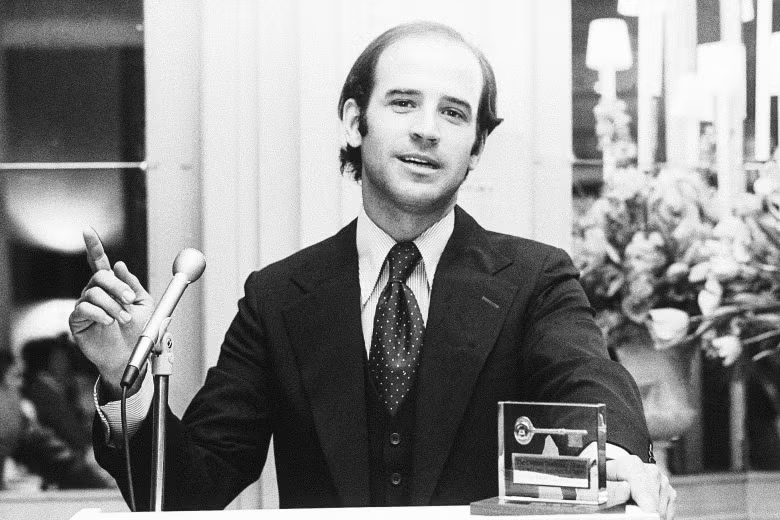
On December 18th, 1972, Neilia Biden set out to go Christmas shopping with Biden’s two boys and daughter when, tragically, a tractor-trailer plowed into her station wagon, killing Neilia and Biden’s two-year-old daughter Amy and critically injuring both Hunter and Beau. Grieving from the loss of his wife and daughter and given the condition of his two sons, Biden considered forfeiting the Senate seat, but at the urging of colleagues across the aisle, Biden stayed in and was sworn in at his children’s bedside in hospital and made the commitment that if “any conflict were to arise between me being a Senator and being a good father, I will resign the Senate seat.” Committed, Biden would take the two-hour commute from Washington to Willmington after each Senate session concluded to spend time with his two sons.
Early Senatorial Career and Meeting Jill Jacobs
Biden’s early career as a Senator was focused on prosecuting the case against then-President Richard Nixon’s public fall from grace in the aftermath of the Watergate Crisis. Biden decidedly was known for his candor and ambition, stating in 1974, “You’re being phony to say you’re not interested in being president if you really want to change things.” The young Senator led the charge for consumer protection and environmental issues and would controversially be known as one of the leaders at the helm of preventing race-integrated busing. In 1976, Biden supported a measure forbidding the use of federal funds for transporting students beyond the school closest to them. Around this time in 1975, Biden was set up on a blind date by his brother Frank with University of Delaware student Jill Jacobs, eight years his junior, and after dating for two years and five proposals on Biden’s part, they married in 1977.
Biden’s senatorial career continued to rise, and in 1981, he became the ranking minority member in the U.S. Judiciary Committee. Coupled with being a Democrat floor manager for the passage of the Comprehensive Crime Control Act of 1984 with many “tough on crime” policies that’d be controversial later on in his career, his star did not wane, and encouraged by his rise to stardom; he would seek the Presidency for the first of three times for the 1988 campaign.

Robert Bork, 1988 Campaign, Later Senatorial Career
Senator Biden announced his intention to run for the White House in February 1987 with progressive messaging about how he “had marched in the civil rights movement.” This, along with a flurry of other claims, would eventually be the factors that sunk his campaign; among these claims included a confrontation with a reporter stating that he had graduated at the top of his class at Syracuse University, which was not the case. Biden actually graduated near the bottom of his class. Still, the most egregious of Biden’s acts during the campaign wasn’t the claims but his plagiarism of British Labor Leader Neil Kinnock’s speech at a Democratic primary debate at the Iowa State Fair. These converging circumstances and the fight in the Senate Judiciary Committee over Reagan Supreme Court Nominee Robert Bork drew Biden to drop out of the race in September 1987.
Biden’s political fortunes, while admittedly down on their luck after the calamity that was his ’88 campaign, would quickly pick up after leading the charge against Supreme Court Nominee Robert Bork. Bork was an avowed originalist and former Solicitor General of the United States who did not support civil rights or the Roe V. Wade decision. Biden, after 12 excruciating days of hearings, would succeed in sinking Bork and influencing the course the Supreme Court would take for decades to come. Of his failed Presidential run, a failure lingering in the background, he would quickly come to state that “there will be other opportunities for me to campaign for Senate. But there will not be many other opportunities for me to influence President Reagan’s choice on the Supreme Court.”
Through the Clinton administration, Biden would help pass a ban on assault weapons through the Crime Control and Law Enforcement Act and the Violence Against Woman Act, which helped protect victims of domestic abuse. In 1996, Biden affirmed the Defense of Marriage Act, which prohibited the government from recognizing same-sex marriage, coupled with a provision banning gay people from the military. Once again, Biden would have a say in a Supreme Court nominee, Clarence Thomas, a process that would dog him in his next two presidential runs. Biden, chairing the hearings, would not allow full testimony of other witnesses besides that of Anita Hill, a University of Oklahoma law professor, accusing Clarence Thomas of compromising activities.

The 2000’s, 2008 Campaign, and the Vice Presidency
Biden would emerge as the ranking minority member in the Senate Foreign Relations Committee and would support President Bush’s military endeavors in a post-9/11 world. Biden supported the war against Afghanistan and voted for the war in Iraq in October 2002, declaring, “Whatever it takes, we should do it.” Biden’s increasing confidence in voicing his own opinions launched him once again into the Presidential orbit, whose prospects were even dimmer than those of his 1988 campaign.
The 2008 campaign was a long shot bid in the first place, with the heir apparent to the Democratic nominee, Hillary Clinton, set for a coronation on the floor. Of course, this was before a young, nobody Senator from Illinois, Barack Obama, would rise from obscurity. Obama’s rise had been like nothing yet seen in American political history, from delivering a rousing keynote speech at the 2004 convention and winning his senate seat in a landslide to pulling off surprise after surprise for the Democratic nominee: Barack Obama became the force within the Democratic Party. Biden originally resented the political rise of Obama and everything in the direction he was taking the party in. Obama reciprocated the same negative feelings, and until a meeting in 2007, it remained that way. This tension eventually cooled, and after Obama’s victory in the primaries, Biden was selected to be his vice presidential running mate after Obama recognized the appeal the gaffe-prone man from Scranton could have on the general electorate. This pick was made out of a strategy to appeal to Hillary Clinton voters alienated after the primary, and in the end, it worked as intended. Biden was able to aid Obama in critical rustbelt states like Pennsylvania and Ohio and firmly defeat friend and Republican nominee John McCain.
In governance, Biden proved a critical partner in passing legislation as his senatorial chops made up for Obama’s lack of experience. He lobbied heavily for the Affordable Care Act and proved a quintessential piece in negotiating this legislation through Congress. More legislation like the 2009 Recovery Act and Strategic Arms Limitations can also be attributed to Biden. After years of close partnership with Barack Obama, it looked like the third presidential run would be the one to finally catapult him into the White House. Again, tragedy struck the Vice President. Biden’s son Beau would contract glioblastoma and succumb to it in 2015, along with Obama’s preference for Hillary Clinton as the nominee made him accept his fate and decide against another crusade for the President. Hillary Clinton would then go on to lose to Donald Trump, and Biden would hold resentment towards Obama for urging him not to run, convinced that he was the man to defeat Trump. It seemed the old fox was out of time and tricks, but this wasn’t so for long.

2020 Presidential Run and End
After the 2017 Charlottesville Nazi riot, Biden decided (according to him) to run against Trump in the 2020 campaign. This campaign seemed to be a repeat of 1988 and 2008 when it looked like the Democratic party electorate had no appetite for his candidacy and instead looked towards Vermont Senator Bernie Sanders. After a disappointing in Iowa and New Hampshire, it seemed that Biden was all but doomed: enter Jim Clyburn. Clyburn, an institution in South Carolina, endorsed Joe Biden, declaring, “We know Joe.” This endorsement saved Biden’s political career and put him in the position to sweep South Carolina and win overwhelmingly on Super Tuesday. Then, after a contentious campaign in 2020, where the country experienced a crisis it hadn’t experienced in more than a century, and political norms were turned on their head, and after days of counting votes, Biden would finally ascend to the White House with running mate Kamala Harris (D-California). Biden had finally reached the top after years of fighting: he reached the top of Olympus, but glory could only hold for so long.
Biden’s age, now far past his prime, began to drag heavily on prospects for re-election, but he pressed on. Biden, seeing himself as “the underdog,” pressed on toward the 2024 campaign, touting his record and experience. When the walls began to close in after a disastrous debate performance, a dramatic fall would ensue. After weeks of denial and hemorrhage within his own party, it was over. Old advisors came knocking at the door, saying it was now impossible for him to be victorious. The old fox, marked with years of experience and tribulation, would finally succumb to the pressure of the age, and on Wednesday, July 24th, he would give his political eulogy. In that speech, sure to go down in the annals of U.S. history, he acknowledged that his time was over and that a new generation of leaders time had come.
Biden’s decision and long political career will stay in the American canon and will certainly not be forgotten. That much can be said about Biden, despite whatever side of the aisle you may find yourself on. His mark has surely been felt and his influence will certainly be felt for years to come.


Leave a Reply