
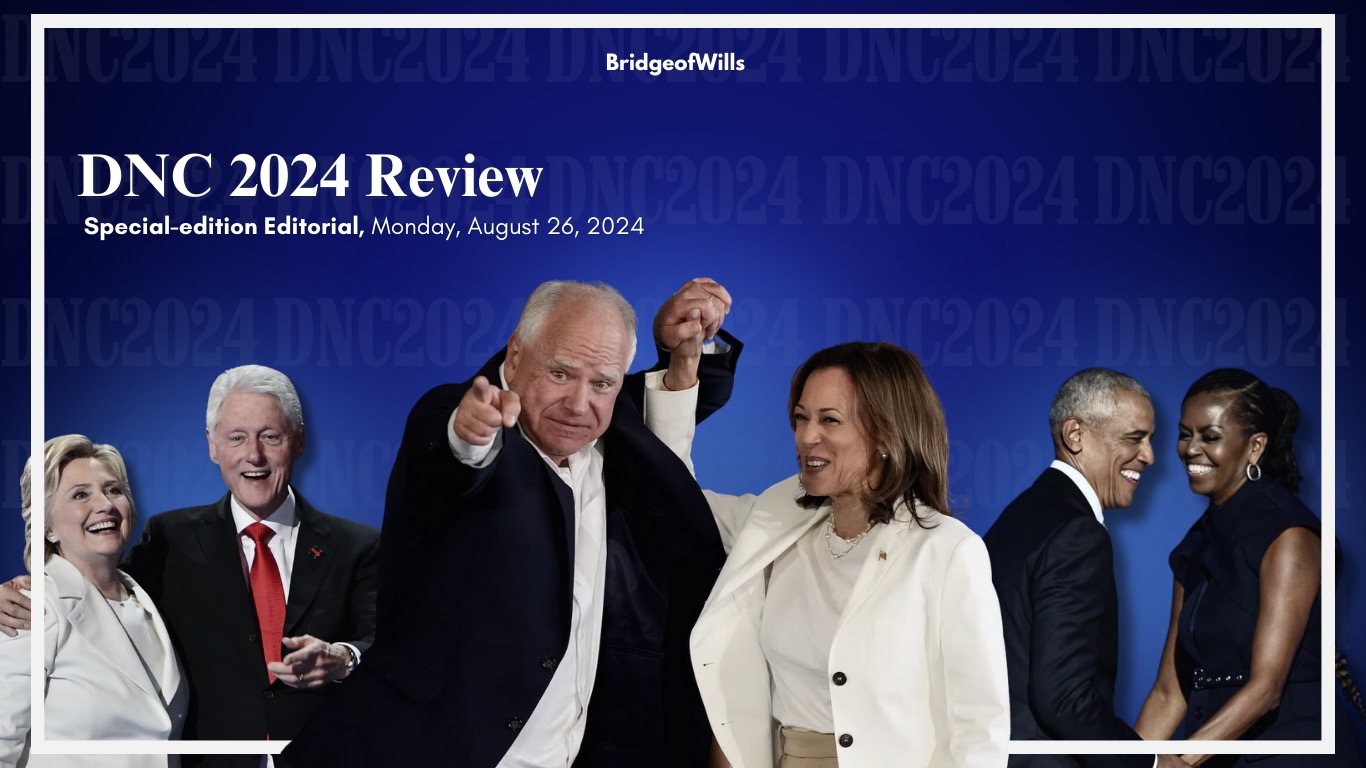
Seventy-one days until election day, we’re right off the presses of the DNC convention. The Democrats’ Convention was full of exuberance and a sense of hope that has entered them since the dramatic departure of President Biden. This Convention was full of star-studded speeches from heavy Democratic hitters like the Obamas, Clintons, Governors, and more. However, the exit of RFK from the race and his endorsement have shaped the dynamics in a move to try and blunt the Democrats’ momentum following their Convention. Polling after the Convention has been scarce, but evidence of a bump is showing in the very preliminary polls; time will tell if the momentum continues to stay one-sided or if the Republicans can blunt it and win a victory in November. Given the intense nature of Presidential politics as the campaign enters full gear, this State of the Race solely focuses on Presidential election prospects as more race updates will be saved for our gargantuan Labor Day update next week. Here’s what’s changed since our last State of the Race:
The Democratic National Convention Day by Day
Early on, the Democrats’ Chicago Convention eerily drew parallels to the fraught 1968 convention, in which a sitting vice president was nominated to take on the mantle of the Democratic party. The circumstances: a sitting President dropping out because of internal pressure from his party, a foreign policy that drew away young voters and led to mass protests on university campuses across America, the rise of a Vice President onto the ticket, and the threat of massive protest outside the Convention. History rhymes, but in this case, it didn’t determine the rhythm; the Democrats’ Convention was received positively, garnering an average of 21.8 million viewers over the course of the four days compared to the Republican’s 19.1 million according to Nielsen ratings. While protests did occur outside the walls of Chicago, they remained mostly peaceful, and only 74 arrests occurred. The turnout, which was expected to be 20,000, was estimated by police to be between 4,000 and 6,000; this was much different than the fraught 1968 convention. Each night of the Democratic Convention represents a different facet of the Democratic Party and its evolution up to now.
Day One: Farewell to the Old Guard
Three appearances rocked the first night: a blistering speech by Shawn Fain, which attacked Trump’s record on labor unions in an attempt to blunt his union appeal, a vengeful Hillary Clinton coming back to drag Trump down from the graveyard of defeated Presidential candidates, and the swan song for a career that has spanned more than 50 years for President Biden.
Shawn Fain’s speech sought to nip Trump’s labor union focus in the bud after Teamsters President Sean O’Brien was the first President in the union’s 151-year history to speak at the Republican National Convention. The strategic importance of union members in key states like Wisconsin, Michigan, and Pennsylvania, with exceedingly high rates of union membership, becomes pivotal for both campaigns. O’Brien pushed an admittedly choreographed line with shouts of “Trump is a scab” (a scab referring to a worker who does not wish to join a union and does not stand in solidarity with the strike). The appeal to union workers was catered uniquely; 20% of all Democratic delegates belonged to a union, and every delegate stayed inside union hotels. This was one angle the Democrats attacked on.
Hillary Clinton’s speech called upon the phantom of her 2016 campaign; this call was based upon the “breaking of the glass ceiling.” She called upon a future for the Democratic party that didn’t arrive in 2016 but beckons that it arrive now in 2024. She defiantly stated, “Together, we’ve put a lot of cracks in the highest, hardest glass ceiling,” “On the other side of that glass ceiling is Kamala Harris raising her hand and taking the oath of office as our 47th President of the United States.” In what was sure to be a cathartic moment for her, chants of “lock him up” reverberated across the convention hall in a reversal of a chant that has so haunted her since 2016.
President Biden’s speech, his swan song after a long and winding road that marked the sunset and the passing of the torch of the old guard of the Democratic party, which he so desperately fought early on to maintain its integrity, was the cornerstone of the night. Biden recounted tales from across his career and the progress he has made during his tenure as President; even in this speech, there still seems to be some rawness over his dramatic exit in July. Biden launched underhanded attacks against the media and pressed the case his now-dead campaign was basing its chances on the threat to democracy brought by Donald Trump. Biden launched an oratory piece that spanned over an hour, recounting the same lines of attacks that Democrats have utilized with some light touch and a final piece of gratitude on his part, with a heartfelt “I love you, America.”

Day Two: Obamas’ Night
Night two was dominated by Michelle and Barack Obama, who echoed the themes of their 2008 campaign that launched their unlikely bid into the spotlight. These superstars of the party, who have been silently moving the wheels even though their time in the White House has nearly been a decade since its end, show that their influence is indelible in the current Democratic Party.
Michelle Obama called upon the rising sun of hope that is “making a comeback” in America. Obama utilized colorful references to her recently deceased mother’s life and how she instilled the values within her that she also sees reflected in Harris. She asserted that Harris was more than ready to take up the mantle of the White House, saying, “My girl, Kamala Harris, is more than ready for this moment. She is one of the most qualified people ever to seek the office of the presidency. And she is one of the most dignified. A tribute to her mother, to my mother, and to your mother, too.” The omnipresent chants of hope sung in a medley with her husband’s speech set the tone the Harris’ campaign has taken up to now, and it seems it will continue straight through to the election.
Barack Obama’s speech was the knockout of the second night of the Convention that turned his iconic phrase of “Yes we can” to “Yes she can.” He utilized the standard Democratic talking planks and urged voters to not boo, but vote. However, past all of this, Obama had a unique message to Democrats that almost seemed to warn them against leaning into the image of identity politics, stating that “After all, if a parent or grandparent occasionally says something that makes us cringe, we don’t automatically assume they’re bad people.” This appeal to white working-class voters perfectly leads into the focus of night three, headed by Bill Clinton and Tim Walz.

Day Three: Appeal to the White Working Class
Walz’s, Clinton’s, and Pelosi’s night touched upon the very themes of hope the Obamas had set up the night before.
Clinton evoked memories of his now long past heyday in the 1992 campaign, where he campaigned upon the very “change” that washed away the losses of the Democrats to the hands of Republicans in three presidential elections in a row (1980, 1984, 1988). Clinton called upon endurance and the necessity for “toughness” in the face of Republican adversity and called for creating an America that works for everybody, not just those at the top. This clearly connects to his 1992 campaign, which sought to campaign against 12 years of Reaganite corporate tax-cutting for the wealthy.
Nancy Pelosi’s speech, speaker Emeritus of the House of Representatives, delivered a speech akin to that of Biden and Clinton and performed the proverbial passing of the torch to a new younger generation of Democrats. Pelosi acknowledged that she had not spoken with Biden since he dropped out of the race in July, and at that moment of the proverbial passing of the torch, she stated that Harris “would take America to new heights.”
Tim Walz’s speech was marched with his usual tongue and cheek midwestern candor that opened the speech with, “You might not know it, but I haven’t given a lot of big speeches like this,” Walz hit upon the fundamental planks that have connected him to the working class focusing upon his push to grant universal free lunch to students across the state of Minnesota and other endeavors like granting free college tuition to students in Minnesota. Walz triumphantly stated, “We’ll turn the page on Donald Trump,” That’s how we’ll build a country where workers come first, healthcare and housing are human rights, and the government stays the hell out of your bedroom.” Going further and stating in his most explicit appeal to white working-class Americans, “If you’re a middle-class family or a family trying to get into the middle class, Kamala Harris is gonna cut your taxes. If you’re getting squeezed by the price of your prescription drugs, Kamala Harris is gonna take on Big Pharma. If you’re hoping to buy a home, Kamala Harris is gonna help make it more affordable. And no matter who you are, Kamala Harris is gonna stand up and fight for your freedom to live the life you want to lead. Because that’s what we want for ourselves. And that’s what we want for our neighbors.”

Day Four: Enter the Apotheosis
Harris’s speech was the spotlight of day four and the closing of a chapter for the old guard of Democratic politics and into the new party era. Harris stressed that she is well equipped to handle the prosecution of the case against Donald Trump. She stressed her background working in McDonald’s to pay her way through college, but the overarching theme of her speech was change from the era of Trump and Biden to something younger and newer, “Our nation with this election has a precious, fleeting opportunity to move past the bitterness, cynicism, and divisive battles of the past,” Harris said, “a chance to chart a new way forward, not as members of any one party or faction, but as Americans.” Notably, in a move that has inflamed the pro-Palestine wing of the Democratic party, she reaffirmed America’s commitment to supplying weapons to Israel and defending her sovereignty while also acknowledging the death of thousands of Palestinians in this brutal conflict. Harris continues to walk the fine line between supporting Israel and placating the pro-Palestine wing of the Democratic party.
With that, the Democrats convention ends, and now the campaign shifts into high gear as it sticks the landing in this turbulent time until Tuesday, November 5th.

Donald Trump
RFK’s Support
The former President scored a huge endorsement of Republican RFK Jr., who, after long negotiations and attempts to negotiate with both major candidates. Harris refused to answer any phone calls from the former Independent presidential candidate while Trump entertained his ideas as polling showed that he was sucking away support from the former President. Kennedy, under the guise of free speech being under attack, dropped out on Friday and endorsed Trump at a harrowing Arizona rally to try and blunt the momentum the Democrats have coming off the Convention. Kennedy has adopted the slogan “Make America Healthy Again,” as Trump is sure to appoint him to a position regulating food to try and create a “healthier lifestyle” for Americans. Kennedy, just days before endorsing and campaigning with Trump, attacked him with a scathing ad meant to rail against the two-party system and discourse created.
Kennedy has moved to withdraw his name from state ballots in all except six very heavily Democratic states in an attempt to try and draw away votes from Harris and not allow his candidacy to impede upon Trump getting elected in November through the critical seven battleground states.

Ratings Changes:
Probability Ratings


The ratings have remained the same since the last State of the Race as Bridge of Wills awaits more polling from the post-Democratic Convention.

Leave a Reply