
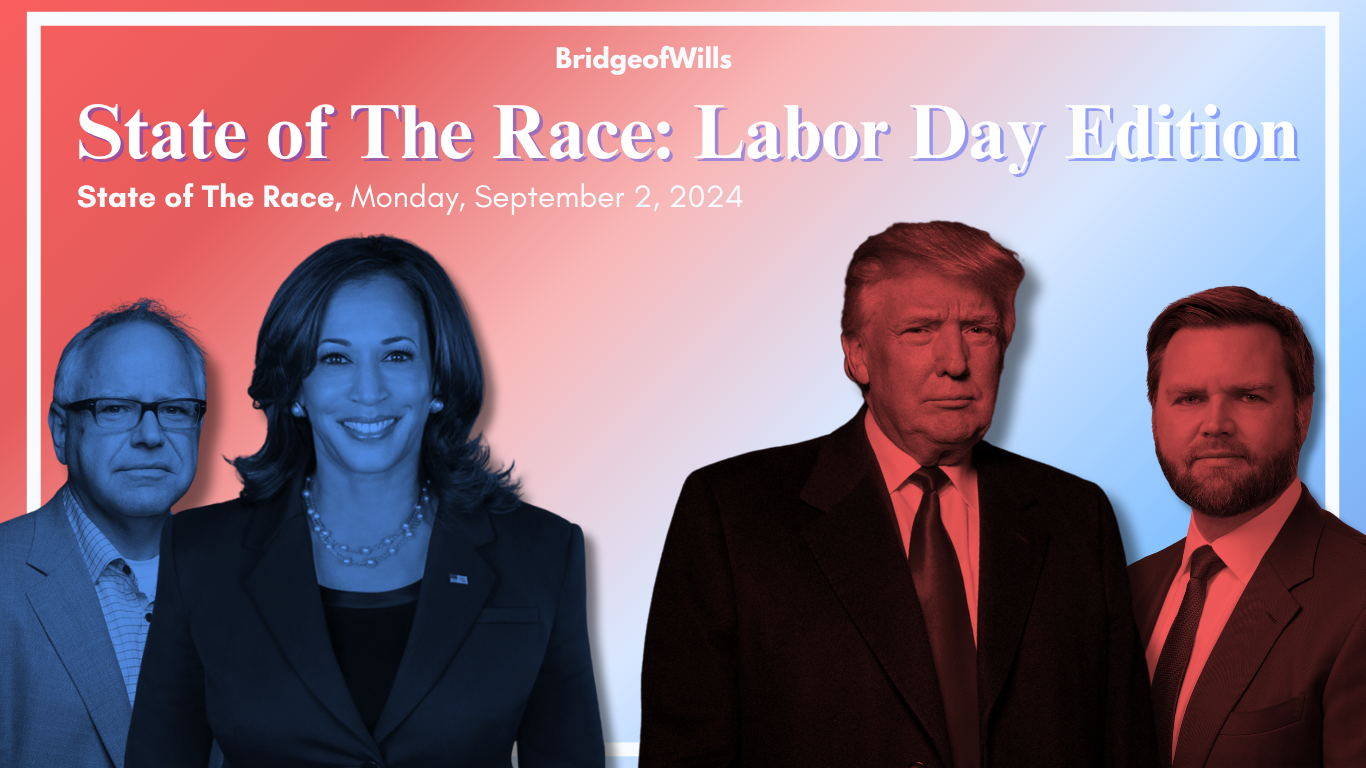
Sixty-three days from election day, the apotheosis point for this race has arrived. The race to the finish line begins now as Trump and Harris rush to make their case to the American people and push undecided voters in their camp. Across the battleground states and in the national polls, Harris’ numbers have seen a post-Democratic convention boost as her momentum has no signs of sagging. The Trump campaign is zoning in upon the upcoming September 10th debate as a way to reverse the momentum and blunt Harris just as they were able to do with President Biden forcing him to exit the race. This race, despite Harris’ momentum, is still a tossup: the election is likely to drag into the early hours of the morning, and the next 63 days will be anything but boring. In this State of the Race Labor Day Edition, we seek to gauge the mood across the country at all levels and swing states. Let’s see what’s changed since the last State of the Race:
Kamala Harris
CNN Interview
In her first full sit-down interview since becoming a candidate, Harris’ seemed to focus on the aspect of hope that her campaign has garnered for Democrats but seemed to evade specific questions like “What would you do on day one.” This particular question drew vague answers, such as the “implementation of an opportunity economy,” but there was no talk of executive orders or specific actions. Harris continued to attack Trump’s record on COVID-19 to remind voters of how things were when Trump left office in a period that seems like a millennia ago; a particularly interesting response was when anchor Dana Basha asked Harris if “Bidenomics” was a success, to which she gave no direct answer.
Harris’ stance changes also became evident when asked about fracking (to which she favored a ban in 2019). She stated in this interview that she did not favor a ban on fracking and continued to press her and Biden’s environmental record and other legislation like the Inflation Reduction Act. Harris continued to press the Biden administration’s support for Israel’sright to defend itself without wholly stating the administration’s stance on selling weapons to Israel. The last bit of information served as an advance by Bash to try and push back Harris’ repeated assertions that Biden could handle the race when before him dropping out: Harris evaded this question and praised his record over his long career and simply stated as to how Biden called to inform her as to how he was leaving the race.

The Debates
The matchup of the candidates may have changed, but the strategic importance of the debate is the same. It was clear back on June 27th during the first Presidential debate that a bad performance could be the death knell for a candidate. The Harris campaign is attempting a strategy that is much different from that of the former Biden campaign. Instead of pressing and attacking the case, she intends not to respond to Trump’s insult but to show that she is capable of talking about how her policies would help the everyday people. Where she intends to jab at Trump is in his “advanced age” (an ironic shift from that of Biden’s strategy) and the various policy proposals he failed to live up to during his first time in office. Harris intends to differentiate herself from Biden during the debate, avoiding vulnerabilities like the Afghanistan retreat. The last and final point she seeks to avoid is an embarrassing moment like the one she had with Tulsi Gabbard during the 2019 Democratic debates and her brutal comment attacking Harris’ record as Attorney General of California.
The Trump debate strategy is no strategy at all, with national press secretary Karoline Leavitt of the campaign stating that “He does not need traditional debate prep because, unlike Kamala Harris, he has a command of the issues, frequently sits down for interviews, and takes questions from hostile news media almost every day.” Despite getting minimal coaching from Tulsi Gabbard, Trump seems confident that he can deliver a knockout blow to Harris just as he did to Biden in June.
A last-minute rules change where Harris sought to revoke the muted mic rule that the Biden campaign advocated for the June 27th debate to allow more back-and-forth banter between the candidates. Trump announced an indifference to the change on Truth Social, but his campaign ardently denied the change, and ABC announced that the rules would remain the same.

Donald Trump
JD Vance
Vance’s favorability ratings have remained routinely unfavorable across the board, with him, on average, down 10.5% in the 538 average. The polling across the rustbelt has shown that Trump’s desired effect from Vance of aiding him across states in the Rust Belt has not materialized. Across polling averages and the latest polls by Emerson Harris reminds tied if slightly ahead of Trump in the state of Pennsylvania. Harris remains tied but slightly ahead in Wisconsin, and she leads in Michigan ever so slightly. This race is as tight as ever, and Vance has not aided in making the case in America’s most pivotal swing states.
On Thursday, Vance was booed by a firefighters union in Boston 24 hours after Tim Walz spoke to the same crowd. Vance laid out the Trump campaign case of being the most “pro-worker” Republican ticket in America. This is the same case that the Trump campaign has pushed since 2016 to appeal to Reagan Democrats in the Midwest and win crucial inroads that allowed him to win in 2016 and might allow him to win again in 2024.

Arlington Cemetery
Last week Monday, the former President participated in a wreath-laying ceremony where it marked the third anniversary of the death of 13 servicemen from the chaotic withdrawal from Afghanistan. While Harris and Biden were not invited to attend the ceremony, Trump decided to attend, but an altercation cast a shadow upon the ceremony. There, a cemetery official attempted to stop the Trump campaign from filming; according to the cemetery, the Trump campaign staff verbally abused the official and pushed them aside. Trump campaign spokesman Steven Cheung rejected the charge, stating, “The fact is that a private photographer was permitted on the premises and for whatever reason an unnamed individual, clearly suffering from a mental health episode, decided to physically block members of President Trump’s team during a very solemn ceremony.”
The families of the servicemen have since posted that they allowed the Trump campaign to film in Section 60 (for recently deceased veterans in the Iraq and Afghanistan wars). Despite this, the Trump campaign’s filming still does not comply with federal law, prohibiting campaign and political activities in cemeteries. This situation remains ongoing and has drawn condemnation from Democrats for the “shameful” behavior of the Trump campaign during this solemn session.

The Sunbelt Swing State Spotlight
Here, we focus on each campaign’s strategies in the key battleground states and specifically where each strategy lies.
Nevada
In Nevada, the game is simple: Clark County. Clark County, the home of Las Vegas, contains 73% of the state’spopulation. Recently, Democrats have been benchmarking 8-10% margins across federal races. This county had a redshift, of course, from 2016 to 2020, whereas Clinton won Clark County by 10.7%, and Biden won by 9.4%. This margin was whittled down to just above 7% in the Senate race in 2022, but another aspect of a Democratic victory is Washoe County, The home of Reno; Democrats have benchmarked better in this county in both 2020 and 2022. Thus, Harris’ campaign needs to focus on running up her margins with service workers to juice out at a bare minimum of a 7.5% victory in Clark and a 3% victory in Washoe.
Trump’s game is the same, focusing on service workers (which he has done by announcing a “no tax on tips” policy to draw these voters in). Trump is banking upon the surge of Republican voter registration that Republicans have had in Nevada since 2020 and the inroads he made with Hispanics in his matchup with Biden. Trump needs to hold Harris under 7.5% in Clark and constrain her margin in Washoe to no more than 2.5% while running up huge margins in rural Nevada.
Georgia
The name of the game in Georgia is very similar to that of Harris, as it was for Biden in 2020, running up the margins in the Atlanta suburbs. While Trump performed somewhat better across central Georgia than he did in 2020, he had an utter collapse in the Atlanta suburbs and exurbs. The shift was so pronounced in counties like Gwinett that it completelywashed away Trump’s 5% victory in 2016. The routine shift of more than 10% across the Atlanta suburbs and the collapse of Trump in the Republican basket of Cherokee County by more than 10% shows the work Trump has to do. Harris needs to match the margins that Raphael Warnock achieved against Herschel Walker in the 2022 Senate Runoff. Harris needs to turn out Black voters en masse to win Georgia; she also needs to maintain a solid margin in the home of Savannah, Chatham County, by benchmarking a similar or greater 19% margin than Biden pulled out.
For Trump, the strategy remains the same: win across the center of Georgia and try and make inroads within the Atlanta suburbs. Trump’s victory relies upon improving margins in places like Gwinett and Cobb County and depressed African American turnout and/or improvements with African American voters. Trump needs to stop the bleeding in the Atlanta exurbs like Cherokee, Paulding, and Forsyth. He uniformly needs to improve in these counties by 3-4% to have a shot at winning Georgia narrowly against Harris.
Arizona
Arizona is another key state that is pivotal to Harris and Trump. A win in Arizona for Harris can supplant a loss in Wisconsin and aid her case in reaching 270 electoral votes. The strategy for Harris is maintaining a similar 2% margin in Maricopa County that Biden pulled in 2020. She also needs to hold an increased turnout in Pima County while holding Trump’s margin down in Yuma County (which he improved upon in 2020 compared to 2016). She has to win Pima by more than 19% to anticipate a potentially greater Trump victory in Yuma, and she needs to benchmark 2.5% in Maricopa as Democrat Katie Hobbes did during the 2022 gubernatorial election against Kari Lake (more on her later).
For Trump, the strategy is simple: lose the overwhelmingly populated Maricopa by less than 2%, increase his margin in Yuma County to above 7%, and hold Maricopa adjacent Pinal County to above 18% for a victory in the state.
North Carolina
The strategy for Harris is to increase the margins in Mecklenburg County and around the research triangle in Durham, Wake, and Orange County. Harris has to increase the margins within these counties by 2-3% to attempt to win the state. She not only has to do this, but she also has to keep Trump’s margin down in exurbs surrounding counties Cumberland.
To win this state, African American turnout needs to surge within the counties mentioned above to push Harris over the top in North Carolina. Polls have shown a tight but improving situation for Harris. The politically vexing state of North Carolina may fall into Democrats’ hands.
Trump has to keep margins in the research triangle narrow and hold the margins he managed to pull in rural North Carolina in places like Robeson and Colombus counties. If Mecklenburg were to surpass a greater than 37% margin for Harris, Trump’s path in North Carolina would be utterly destroyed.
Ratings Change: No Tossup
Nevada Tilt R–> Tilt D
The polling situation has improved dramatically for Harris compared to that of Biden, who was routinely down in the state by a shocking 5% points. This, combined with Harris’s improving numbers with Latino voters across a swath of polling, means that Harris now holds the slightest advantage in Nevada. The Bridge of Wills team says that Nevada will come to below a 0.5% margin of victory for either side and will ultimately be incredibly close.
North Carolina Lean R–> Tilt R
The political white whale of the Democrats has not gone for them on the Presidential since 2008, for Barack Obama is improving dramatically. The latest Fox News poll shows Harris behind by 1%, well within the margin of error. Polling by Survey USA shows that Harris narrowly leads by 1% in North Carolina, and on the 538 average, Trump leads by 0.4%. The Bridge of Wills team is not ready to declare that Harris has an advantage in North Carolina, but this ratings change from leaning to tilt is prudent given the political situation.

The Senate
Arizona
The matchup between Kari Lake and Ruben Gallego has been utterly tragic for Republicans. Kari Lake, the failed gubernatorial candidate who failed to win in 2022, is behind Ruben Gallego by margins exceeding 5% in every single poll taken so far. Lake has vacillated between supporting extreme measures against abortion and supporting softer policies toward banning it on a statewide and national level. Lake is an avid supporter of the former President’s fraud claims, and she herself claims that she was robbed of her victory during the 2022 governor election. Gallego is hammering her for flip-flopping on abortion, given that voters face a choice of whether to establish abortion as a fundamental right in the Arizona constitution. A poll by Fox News shows that Gallego leads Lake by 15%; while this is a clear outlier, it is absolutely warranted to shift the race from Lean Democratic to Likely Democratic. Gallego seems likely to win this Senate race by a 5.9-6.1% margin.
Nevada
Nevada is another state that seems to be on the outer ring of what is possible for Republicans to flip the Senate, and polls show this. Sam Brown’s campaign has operated with radio silence when asked questions relating to Project 2025 and how he has received 5.5 million from Thomas Klingenstein of the Clairmont Institute, which is affiliated with the creation of Project 2025. Brown’s campaign strategy relies upon his service in the US military as a captain, but it seems this strategy isn’t picking up steam at all. Incumbent Jacky Rosen (running for a second term in the Senate) leads by a routine 9-15% in the polling: this results from a likely combination of factors: abortion, incumbency advantage, and surging Democratic energy across America could be pushing Rosen over the finish line. This race is thus moved from Lean Democratic to Likely Democratic.
Ohio
Bernie Moreno, the Republican candidate in Ohio, who is being dogged by scandals relating to his car dealership business, has now been revealed to be opening a Mercedes-Benz leadership in Colombus in Colombus, which will break ground around election time in November. Democrats have attacked Moreno for his business and disputes by workers over their not being paid, so this lends more feeder into the Democratic campaign arsenal. Moreno has also softened deeply on his position on abortion; whereas in 2022, he stated he was “pro-life, no exceptions,” he now favors a Governor Glenn Youngkin of Virginia-esque policy with exceptions and fifteen weeks. Incumbent Senator Sherrod Brown is running a pro-choice and pro-labor campaign and carefully balancing how much input he is receiving from national Democrats, namely President Biden and Vice President Harris. Polling has remained stable since the last State of the Race, where Ohio was documented, so thus the ratings remain the same.

Governor
Race Spotlight: North Carolina
This is the hottest race in the governorship, so hot in fact that Roy Cooper demanded his name be taken off Harris’ VP shortlist because he wanted to focus on the internal drama happening because of this race. Lt. Governor Mark Robinson is running a controversial race against North Carolina Attorney General Josh Stein. Robinson has made a series of bizarre remarks where he states that some folks just need to be killed, and a serially hardline position of abortion that includes no exceptions for abortion, favoring a hardline 6-week policy and national abortion ban. From what little polling has come out, Josh Stein holds a commanding lead over Robinson as he has been trying to pivot more towards the center. This race is being moved to Likely Democratic from our initial Lean Democrat early on in the summer.


Leave a Reply