
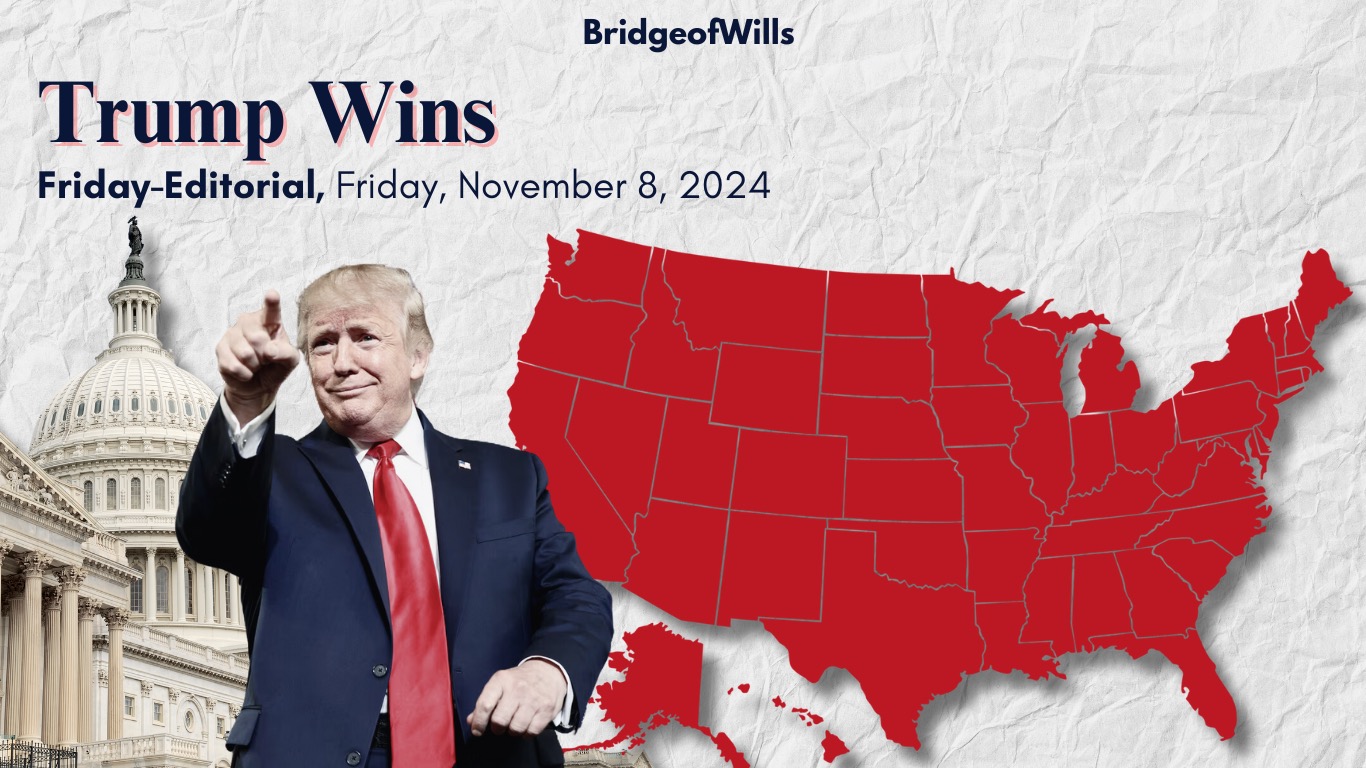
It submerged all corners of the country. The tsunami came in waves as millions of hopeful democrats saw their hopes drowned as Kamala Harris, who had provided hope in an election that seemed destined to be won by Trump with Biden in the race, went down in a crushing defeat. Trump defeated her by carrying all seven swing states and becoming the first Republican to win the popular vote since George W Bush in 2004.
The election represented a complete repudiation of the Biden/Harris administration as members of the Democratic coalition abandoned them en masse, a coalition forged by Barack Obama and one that Donald Trump made serious inroads with. Democrats weren’t just abandoned at the top of the ticket; they suffered down-ballot: in the Senate, they lost Senator Bob Casey (who was expected to easily win re-election in pre-election polling), Sherrod Brown who was favored to win in Ohio according to polling, and Jon Tester who lost by a wide margin against Republican Tim Sheehy. The bleeding doesn’t stop there; Ruben Gallego, who was routinely ahead in the polls from 5-10%, is in the fight of his political life against Kari Lake, a candidate who lost the governorship against Katie Hobbes in 2022. Democratic incumbents who had entrenched themselves as popular in their districts/states either suffered achingly close victories or straight losses against their Republican opponents.
Now, three days after election day and as the debris is being cleared, two questions emerge: what happened? And why did this happen? The former question will be answered today, and the why will be answered in a forthcoming “What went wrong for Harris” tomorrow.
The Eve Before the Election
Harris
Democrats were energized at Harris’ last rally in Philadelphia at the Philadelphia Museum of Art, immortalized by Rocky running up its steps and declaring himself triumphant. So, too, was the mood of the Democrats triumphant. Harris fired up on all cylinders, bringing out the highest caliber of star power available, bringing in Fat Joe, Lady Gaga, Ricky Martin, the Roots, Will.i.am, and Oprah Winfrey. The Trump era seemed to finally come to a close as Harris triumphantly declared, “One more day, just one more day in the most consequential election of our lifetime, and momentum is on our side.” The various blunders of the last week by the Trump campaign, after comedian Tony Hinchclifee called Puerto Ruco “a floating Island of Garbage” at Trump’s Madison Square Garden rally, forced the campaign to walk back after Puerto Rican celebrities endorsed Harris in droves. Pre-election flash polling suggested this gaffe would hurt him with Puerto Ricans in key states like Pennsylvania. Not only this, it seemed Trump would bleed with Republicans after he said Liz Cheney should be put in front of a “firing squad” for being a “war hawk.” And more of Trump’s generals warned that he was a “fascist” hellbent on destroying American democracy. The election was close, but to Harris’ supporters, it seemed like a lock.
Those almost 30,000 people (estimate suggests) who converged at the museum felt the air of victory blow as the joy strummed from every corner, but the eerie specter of 2016 was a cloud upon the rally. For the crowd and those on stage, they hadn’t forgotten the trauma that 2016 had imbued after Hillary Clinton, prepared to become the first woman president it seemed like, suffered a crushing defeat. That negative whiplash seeped into the messaging as Harris warned against the dangers that Trump would bring as the messaging jumped between joyous chants of “Yes she can” (a play on Obama’s 2008 yes he can), and faces transfixed upon the danger that a second Trump presidency would bring in their eyes.

Trump
As the Democrats rallied in Philadelphia and across the Midwest and Southwest with surrogates and Tim Walz rapidly stumping the swing states, there stood Donald Trump, a man who stood as his own army swamped the swing states in a back-breaking campaign schedule that started his day in North Carolina and would end it in Michigan.
The polls had been tight all the way up to the stretch, and while the Trump campaign seemed to have had momentum in the final weeks before the campaign as Harris suffered her own blunders, it seemed it was fleeting away from the Republicans. In North Carolina, he stayed disciplined with his message: North Carolina became the center of attention for both campaigns as it represented the “white whale” for Democrats as they had not won North Carolina on a federal level since Obama’s narrow victory in 2008. Both campaigns knew of its significance; for Harris, it would be one of the “kill states” that would end Trump’s chances at 270 right then and there; for Trump, it was essential for any hope of reaching the White House again.
Trump focused and honed in on the message he wished to convey, as he stated that he wouldn’t start losing North Carolina now as he had carried the state in both 2016 and 2020. The points ranged from his guarantee of a 25% tariff on Mexican imported goods unless they halted the “criminals and drugs coming into the country” to attacking Harris as a “low IQ individual” who was not fit to become the President. In the myriad of points, the message remained the same: are you better off than you were four years ago? The fundamental angle of the Trump campaign, as numbers showed, was a commanding lead with the economy and the southern border, which Americans likened to a worsening of their standing over four years.
In Pennsylvania, Trump continued his crusade as the important state was proving itself to be the quintessential swing state that would determine the whole election. As Republican strategist Charlie Gerow aptly stated, “As Pennsylvania goes, so will go the nation.” In Reading, Trump continued to stay on message as he blamed the Biden/Harris administration’s failure over both the southern border and crime; the Reading stop seemed logical as the ruby-red Lancaster county home to ancestral labor union Democrats carried him to the finish line in 2016 would hopefully provide the numbers necessary to carry Trump over the finish line, but there was something more. Reading is a city that identifies itself as 70% Hispanic, and there was the bold play of the Trump campaign. Polls suggested that there were stirrings of the creation of a brand new coalition that included Latinos that, if numbers held true, would spell real dangers for Harris in the sunbelt states. For now, that seemed like a conjecture for the Trump campaign as he soldiered on to Pittsburgh.

Jointly, JD Vance, who was lifted to the VP slot and, if Trump won, would become one of the youngest VPs in US History. There, Vance finished by echoing Trump’s message with more poise and polish than Trump’s raw style could refine. JD Vance, a Yale man, finished in Atlanta as Trump continued his crusade through Pennsylvania and then into Michigan; he called Kamala Harris “trash” that needed to be taken out, a play on Biden’s comment of calling Trump’s supporters “trash.”
As Trump finished his crusade through Pennsylvania, he finished his 2024 campaign and his final presidential campaign rally ever in Grand Rapids, Michigan, where he ran through the motions. Still, there was something more broadly significant to him. Trump’s final rally for his 2016 campaign was held in Grand Rapids Michigan, and now, Trump led a rally where he sought to prove himself again and replicate the miracle he had pulled off in 2016, and indications were that maybe that miracle wouldn’t occur. Throughout the day, his crowd sizes were smaller than usual, with empty seats filling the venue in what conventionally should be packed seats on the eve before the national election and when election fever should be at its highest, but it didn’t seem the case. But for Trump, “conventional” did not seem to apply to him, and thus, he finished with a final emotional appeal lamenting the fact that this was his last election rally ever and that he truly appreciated the support that Americans had conferred upon him. The cards Trump was dealt with in the final week seemed not ones of a winning campaign, but what awaited during election night was a much different scene.

Election Day and Night
Election day was filled with promising signs from Democrats; even though Republicans had built up a solid lead in early voting in the multitude of swing states, big cities and suburbs were turning out for Democrats. Philadelphia, Milwaukee, Detroit, and even Austin, Texas, were coming out as turnout was reaching the numbers necessary for a Democratic win. The Harris campaign seemed calm and ready, as Harris herself placed last-minute phone calls to try and jazz up some final turnout to end the Trump era of politics. The numbers seemed solid, and the Harris campaign predicted an electoral vote victory of somewhere between 292 to 319 electoral votes: everything seemed ready for the first woman President to ascend and take the White House.
Trump, in his own right, voted on election day and started to point to signs in Pennsylvania and “massive fraud” occurring in the Democratic bastion of Philadelphia. There seemed to be a chill entering Trump as he answered questions from the press after voting; his face was set with exhaustion and almost an air of defeat entering him, but the winds of victory began to shift towards him later on in the afternoon. Still, according to the polls, this race would be won by the slimmest margins, and the campaigns made no illusion of this.
As the hours closed and the first exit polls released at 5:30, it revealed a mixed bag for both the former President and Harris: for Trump, strength was shown as he held an advantage over the border and a surprisingly strong number among Hispanics with his share increasing by a shocking 14% from 2020 exit polls. However, in the crucial swing states, numbers came out saying that Trump was “too extreme,” and overall, the national numbers said the same. For Harris, Trump only had an economic advantage of just 6%, a marked decline from where the polling said he’d be, but for her, she only held a 4% advantage on abortion, Democrats signature issue since 2022. The numbers showed a muddled picture as to who would win, but the scales began to tile towards Trump as those exit polls suggested that there were the stirrings of a coalition that no Republican had ever dreamed of creating.
As the polls began to close in Indiana and Kentucky, the danger signs began to flash red; Harris was doing much worse than Biden. They were red states, and surely Georgia would vindicate the Harris campaign, but this did not occur. Georgia and North Carolina closed, and very little began to trickle in, but in Georgia, it showed Trump outperforming his rural margins and breaking all turnout metrics. In North Carolina, there was some encouraging news as Josh Stein, the Democratic Governor candidate, easily dispatched Republican Mark Robinson by a safe margin: that was the sole bright spot in a horrid night that would ensue for Democrats. More polls closed, and in safe Democratic states like New Jersey and Virginia, there seemed to be a real battle, and Trump was putting up a strong fight. County after county, Trump was putting up solid margins and overperforming with almost every single demographic group. More and more, Trump won Texas by a margin that hadn’t been by since Mitt Romney in 2012, came close in New Mexico, and took Georgia and North Carolina with ease as the metro areas did turn out, but they voted against Harris. Then, the rustbelt began to fall. Pennsylvania, Michigan, and Wisconsin were submerged in the red waves as Democratic incumbents found themselves in the sinking ship of the Harris campaign. At Howard University, the Vice President’s alma mater, the “victory party,” watched the scenes in complete despair as 2016 happened all over again, but this time, tenfold. The Vice President underperformed in deep blue states, and the numbers painted a picture of Trump winning the popular vote. Trump’s tally quickly rose to 246, and a race that was supposed to last days until the count finished was concluded with relative ease.
Finally, Trump, who had been ousted from office 4 years ago in disgrace following violence at the capital that Democrats were sure would end his campaign, rose from the ashes, and with the final call of Wisconsin and Pennsylvania, the Harris blue wall came tumbling down just like it did for Hillary Clinton. Wisconsin, that state which had been the one to lift Trump to become the 45th President of the United States, lifted him again, and with that, after the scandal that would end any regular Presidential candidate, he rose and became the 47th President of the United States.
Donald Trump is the President-Elect, and he will be sworn in on January 20th, 2025.

Results by the Numbers
Sherrod Brown, a three-term incumbent, was shot down in defeat by businessman Bernie Moreno by 5%, as Brown suffered massive losses in the white working-class areas of Ohio, specifically around Mahoning and western “coal country” Ohio lifted by the spurs of a 12% Trump win of Ohio.
Jon Tester, a three-term incumbent, was defeated by 8% in the state of Montana as Trump surged and took the state by a shocking 20% margin. Tim Sheehy, pilot, and businessman, will be sworn in as Montana’s next senator come January 2025.
Bob Casey, a mainstay of Pennsylvania politics whose last name is “Casey” and brings him renown in Pennsylvania, was shot down in defeat by roughly a 0.5% margin (more results forthcoming) by Dave McCormick. This result was an absolute wildcard as no one, not even Republicans, expected to knock off Casey, who is so deeply entrenched in the fabric of Pennsylvania politics. McCormick rode off the coattails of the President-elect, who managed to carry Pennsylvania by a solid 2% margin against Kamala Harris, and with this, Republicans earned their 53rd seat, with a 54th seat potentially forthcoming with Kari Lake.
In the house, Republicans look poised to regain their majority and strengthen it after knocking off incumbents like Susan Wild and Matt Cartwright and hold a commanding lead in various California seats that will determine the fate of the chamber. Right now, Republicans stand at 212, only needing six more seats to retain control of the chamber, while Democrats lag far behind at 200, needing 18 more.
Trump’s coalition, however, is something to behold. Half of young voters (46%) voted for the former President. He increased his share with those without a college degree from 51% in 2020 to 55% in 2024; Trump increased his share of Black voters, specifically Black men, to a whopping 16%, a record for a Republican. But the Hispanic vote was all the more shocking, with Harris only receiving 56% and Trump receiving a historic 42%. That 42% is a record that hasn’t been achieved for a Republican since 2004 when President George W. Bush won 40% of Hispanics. These margins cut into Democratic states: in Illinois, Harris only won by 8%, down from Biden’s 17%. In New Jersey, she won by 5% in a state Biden won by 15%; in New Mexico, a Biden by 11% state down to Harris by six. In Texas, a Biden loss of 5% turned into a Harris loss of 15%. In California, Harris has not broken a 20% margin of victory in a state where Democrats should win with ease and where Biden was able to win by 30%.
The coalition that Republicans were able to assemble is the most diverse in his history, and now, Donald Trump is the President-Elect and is likely to come in with a Republican trifecta, free to enact his agenda and his vision for America.
Link to Results


Leave a Reply