
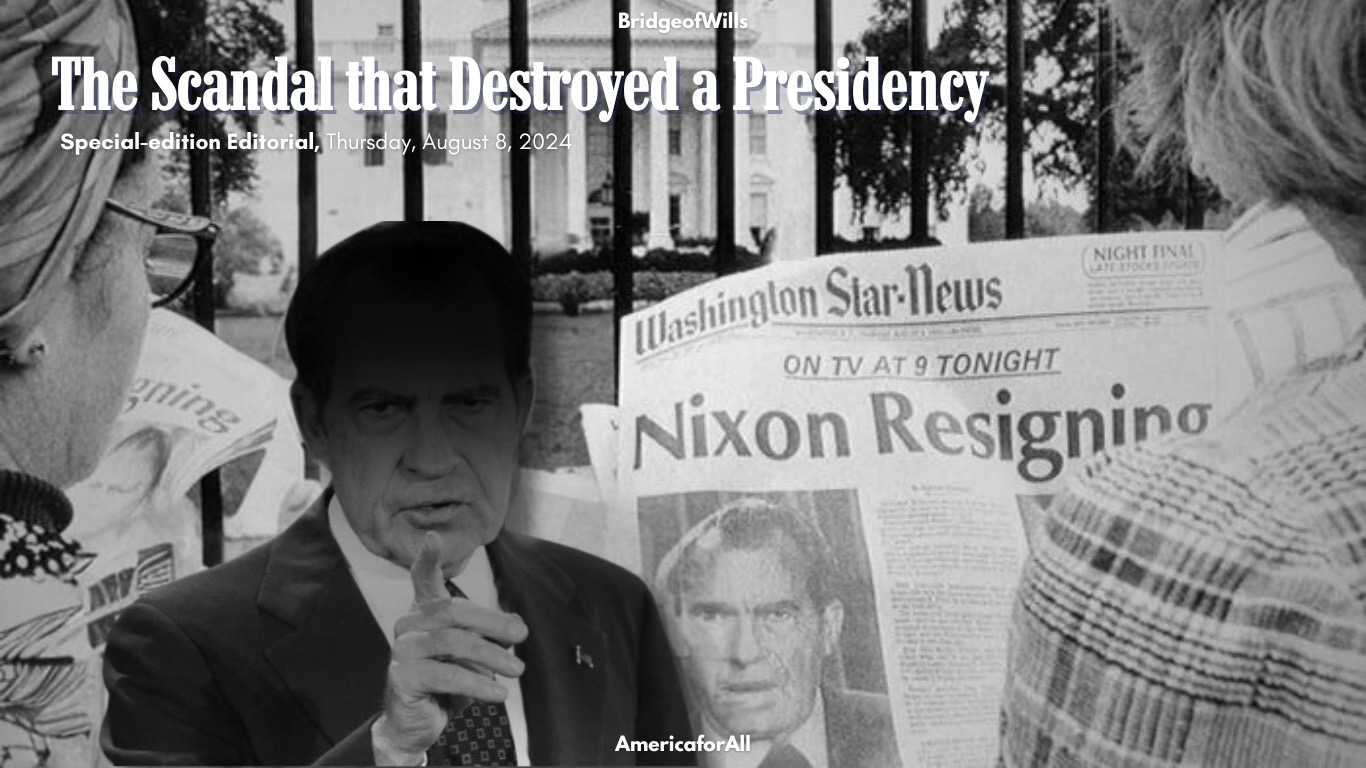
Therefore, I shall resign the Presidency effective at noon tomorrow. Vice President Ford will be sworn in as President at that hour in this office.
Richard Nixon
Fifty years ago, President Richard Milhouse Nixon resigned amid a generationally defining scandal that would forever mar the history of the executive office. When faced with closing walls, the President gave in and acquiesced to his fate, resigning or facing conviction in the Senate. A scandal that did not need to be coming from the paranoia of power of a man who never escaped his humble citrus farm in California, the ultimate insider and outsider.
Richard Milhouse Nixon
Richard Milhouse Nixon was born on January 9th, 1913, to a poor family of Quakers who earned a lowly citrus farm in Southern California. His mother, a “saint” who worked and tended to his sick brothers, two of whom died of Tuberculosis. Nixon never let his mother’s labor leave his mind, and he strived to gain the prestige his family didn’t have. Being born into these humble circumstances, he had all but the tenacity to account for his dramatic academic rise. He aspired to be a man who would mark the “sands of time,” a line from Henry Wordsworth Longfellow’s poem “A Psalm of Life.” He eventually got an offer from Harvard to attend full-ride, but his brother’s sickness and his father’s ailing business forced him to remain on the home front. At Whittier College, he was snubbed by the Franklin Literary Society, filled with the fortunate of which Nixon was not; from that rejection, he internalized the mantra that no matter what he did, they would never accept him. The establishment would not see him as more than a small farm boy from Southern California; he formed a dueling society to counter it. These seeds of disdain for “them” would later become a staple in his brand of politics.

Political Years
After serving in the Navy during WW2, Nixon first won a campaign in the 12th congressional district after no one wanted to challenge the institution the incumbent entrenched within the district. He won his first victory, and now he sets his aims for them. His tenure in the house was pointed at the ideology firmly rooted in the East Coast elite circles at the time: communism. He publicly outed Alger Hiss, a man of high political stature who aided in establishing the UN; Nixon succeeded in destroying Hiss, getting him on perjury charges. Being shot into political stardom, he made his contempt for communism central to his brand, channeling the raw fear of communism by Americans during the Red Scare to win elections. Nixon won a senatorial contest in 1949 using tricks that would earn him the monicker, Tricky Dick; this would stick throughout his political career. Having been chosen as Dwight Eisenhower’s running mate in the assured Republican victory of 1952, Nixon appeared to coast on his way to an executive position, a heartbeat away from the presidency. It seemed assured, but the ghosts of his tricks would come back and haunt him; mid-campaign season, the press revealed that Nixon had a secret political slush fund maintained by political backers. Fissures emerged on the ground Nixon was standing on. Eisenhower was about to drop him from the ticket and thus kill his political career; he would be disgraced in front of the American public and his supporters, but Tricky Dick had a lot of tricks in him. He gave a speech that bends the mind even by modern political standards. The stiff and rigid Nixon bore his soul for all to see on national television, pronouncing his profound love for America and turning, on a dime, the fund into something to feel compassion for. He claimed the only gift he received through the fund was his daughter Tricia’s “cocker spaniel dog, ” Checkers. Nixon had done it. After his triumphant speech, his position was secure on the ticket and eventually as vice president.

1960
Eight years of playing loyal vice president would finally give him his salivating reward, the top office. He would finally do it, proving to those who doubted and denied that he could rise above them despite their rejection at every turn. It seemed secure; the economy rebounded from a bout of depression in 1958, Eisenhower was popular, and the Democrats had a divided field. Nixon would finally be the one, but a slight problem emerged; the man who became the nominee for the Democrats represented everything Nixon was not and detested, John F Kennedy. Kennedy was a young Massasachussets senator who was Nixon’s opposite: telegenic, rich, and handsome. Kennedy had his father pay his way into Harvard, where he earned lackluster grades, slacked off, and slept around with women left and right. After a series of misfortunes that plagued Nixon’s campaign, a disastrous televised debate appearance, a less-than-optimal 50-state strategy, and gaffes on the trail, the results trickled in, and Nixon seemed poised to win early on. A bitterly close defeat came as the night progressed from the jaws of victory. It was all gone; he had lost to the embodiment of everything he cursed into his pillow before he went to sleep; the establishment beat him to his prize.

Comeback
To add insult to injury, Nixon lost a government election in California to incumbent governor Pat Brown in 1962; in his defeat, he gave a bitter concession that amounted to a concession of total defeat. They finally wouldn’t have old Nixon to “kick around anymore.” His press conference served as a bitter eulogy to his political career; he gave them what they wanted: his surrender. His retirement from the arena wouldn’t last long, however, after the destruction of the Republican Party in 1964 after the nomination of Barry Goldwater, who divided the Republican base into a northern moderate-liberal faction and a newly christened southern wing of former democrats. The old pro saw his opportunity and struck with ferocity, winning the nomination and eventually the White House in another squeaker, this time in his favor, against Vice President Hubert Humphrey with tactics that lived up to the name “Tricky Dick.” He had the bully pulpit, and he used it against them he would.

Tonight, I again proudly accept that nomination for President of the United States. But I have news for you. This time there is a difference. This time we are going to win!
Richard Nixon, 1968
The Fall
Nixon’s White House immediately took action against the establishment, who, from his view, seemed to him to have a vendetta just because he was breathing. He wiretapped the “east-coast” reporters and unleashed a volatile and unpredictable Vice President who condensed all his ideals in an unkempt raw form, free of Nixon’s political gleam he had acquired throughout his career. Nixon played the game; it yielded an impressive landslide 1972 election victory, 521 to 17, against Senator George McGovern, who again represented in an extreme form the ‘liberal, draft dodging, drug-using hipped who were degrading and destroying America’ that Nixon vehemently hated. The sweet taste of victory wouldn’t last long. His bag of tricks would soon be on display for all to see. Though it is unclear that Nixon had a direct hand in Watergate itself, he gave a free hand to his campaign to use any means necessary to re-elect him. He’d done action like this before, like ordering a break into the office of Daniel Ellsberg’s psychiatrist (the reporter who leaked the Pentagon papers); this break-in was routine for the Nixon Whitehouse. On June 17th, 1972, a break-in that attempted to wiretap the offices of the Democratic National Convention was caught red-handed. Five men in suits raised their hands, caught like sheepish children who had just broken their mother’s favorite vase. It would lead to their arrest and trickle to the top and knock out Nixon associates one by one.

The Character
Now, on August 8th, 1974, the bitter warrior gave up his fight this time. The pressure was now too high to linger around and fight. The wounded dog didn’t have any more “kick” left in him; it was over, and it was his time to go. In a speech the next day to the White House staff, he decried hatred as the ultimate destruction of a man: “Always remember others may hate you, but those who hate you don’t win unless you hate them and then you destroy yourself.” It’s ironic that a man who made hatred a primary motivator had an 11th-hour epiphany on his political deathbed as he breathed his last gasps for air. The humble country boy became what he swore to annihilate: the same establishment that used tricks to bend will, the same Machiavellian machinations they used. He was never like them, even now, yet he became like them, annihilated by the same vitriol used to achieve their aims. All the embittered disgraced warrior could do was watch forlornly at the White House; with one more glance, the final cruel twist of irony, he looked into the cameras, waved his iconic V for victory, and waved goodbye. It wasn’t them who defeated him. It was Nixon who defeated Nixon.


Leave a Reply