
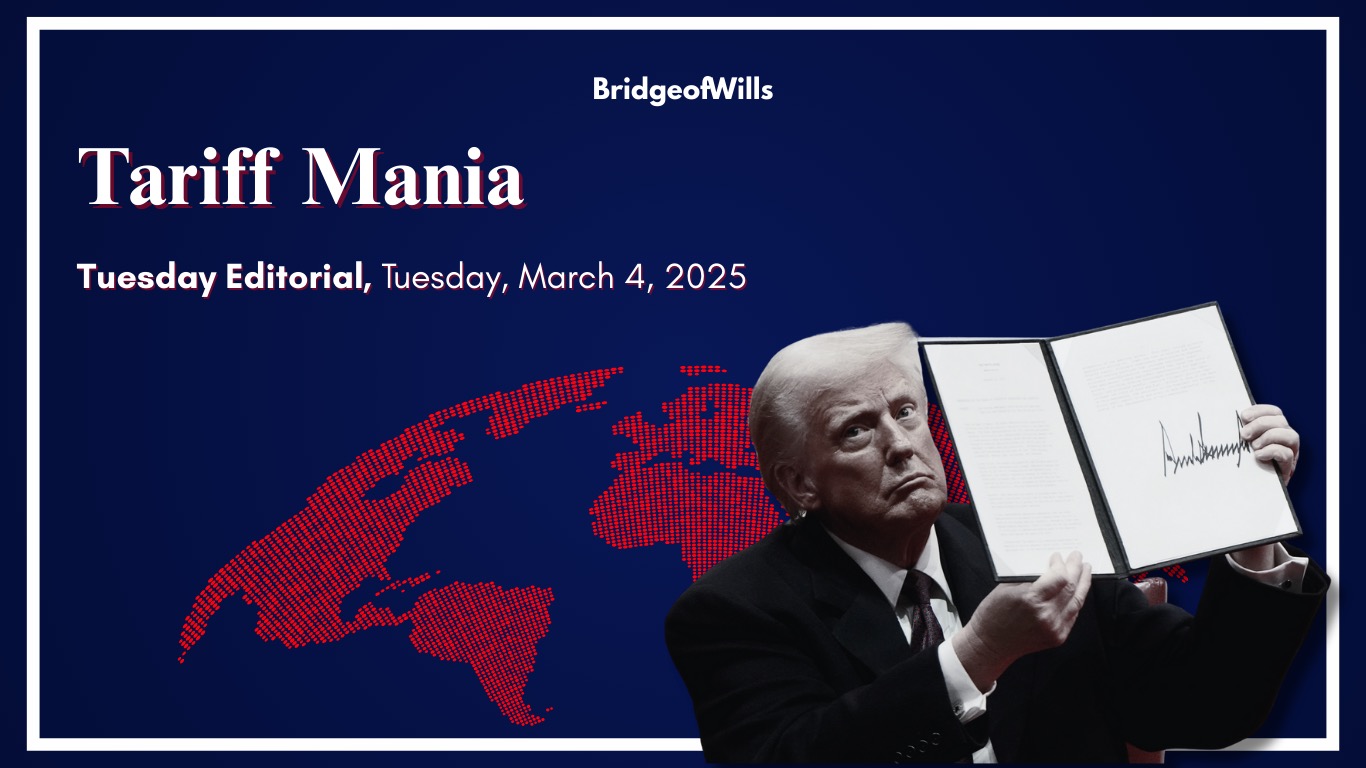
With a surge in the popularity of the word Tariff in recent weeks, many are wondering what this means economically and, even more importantly, what it means for people’s wallets.
What are Tariffs?
Tariffs, simply put, are a tax on goods imported from the country on whom the tariffs have been placed. They are quite literally a fee attached to the entry of a foreign country’s goods. They have been used throughout history for various means, oftentimes falling under the main three buckets of raising government revenue, protecting domestic industry, and achieving diplomatic goals.
Back before the era of the 16th Amendment, which legalized the federal income tax, government revenue would oscillate between being almost entirely dependent on tariff revenue, as was the case in 1860, with nearly 95% of tax revenue being from tariffs, to sometimes being less due to the selling of federal lands. Nonetheless, while the amount did oscillate, government revenue was oftentimes incredibly dependent on tariffs.
The second reason tariffs have been deployed in great numbers in the past—and under Trump’s first term—is the idea that they protect domestic industries. This is absolutely true, as when tariffs raise prices domestically—an issue that will be examined in greater depth later—domestic industry can produce at a profit as opposed to a loss before. This, in turn, brings jobs and economic growth to regions that have these factories now running thanks to the tariffs. This was a primary reason that tariffs would be raised by the 1890 McKinley tariff.
Finally, tariffs act as a political tool in getting a nation to do something. Take for example President Trump’s recent political battle with Mexico and Canada, wherein Trump got both nations to concede to some of his demands as now both nations’s respective heads of state are sending soldiers to man the border and at least ostensibly prevent the trafficking of drugs into America.

Are Tariffs bad?
Short answer: yes. Long answer: it depends.
On May 9, 2019, President Donald Trump asserted that tariffs are “paid for mostly by China, by the way, not by us” after placing tariffs on $50 billion worth of Chinese goods. Many of his supporters have echoed this, believing that the foreign country pays for the tariff. However, simply put, foreign industries don’t just take the tariff, instead, they pass it on to the consumer. Without getting into needless economic jargon about elasticity, consumers will be the ones who bear the vast brunt of the tariffs, and if a 25% tariff is placed on an item, due to the interconnectedness of the world economy caused by globalization, prices will certainly rise by multiple percent if not even close to the full 25%. While this does help domestic industry, this, in turn, is an artificial boost contingent on economies of scale (things becoming cheaper when you produce more) or on the tariffs never being removed. If the former does occur, then in the long run tariffs have helped that industry but if it’s that second aspect holding up the industry, then the political leverage afforded by tariffs disappears.
Then, a smaller but nevertheless important consideration is the damage done to US soft power by tariffs. While President Trump absolutely got a political win out of both Mexico and Canada, this is ignoring the political hazard of them and other nations feeling the need to trade with other nations rather than America if the word tariff is used too haphazardly. One can threaten someone only so many times before they entirely remove themselves from the dangerous situation—in this case ceasing trade with the US, or at least limiting how much.
Finally, and most importantly, tariffs create trade wars. As was the case in his first term, after Trump placed tariffs on China, China reciprocated and nearly destroyed the US soybean industry. Trump had to swoop in and authorize an around $15 billion subsidy to these farmers, which placed a heavy burden on US taxpayers—or it would have been, except it instead was just added to the national debt, which ballooned, in large part to the trade war. Indeed, trade wars are disastrous for countries like the US which are so export-focused and live on the trade agreements that have been carefully cultivated for centuries.
What will the future of the economy look like?
The future of the economy is, as always, uncertain. While tariffs are no doubt dangerous, and China’s recent reciprocal tariffs placed after President Trump’s own ones he established last weekend pay homage to the trade war that happened under Trump’s first term, we cannot possibly predict an exact answer.
By no means is the economy suddenly revitalized or doomed thanks to tariffs, but the recent actions taken by President Trump do have many experts in fear. Many see these tariffs as almost apropos of the disastrous Smoot-Hawley Tariff of 1930, which proved to be a cataclysmic failure and only heightened the effects of the great depression. Considering how precarious the economy is currently in 2025, many do fear a repeat of Hoover’s disastrous tariff policy.

Tariff Mania
After a deal was made by both Canada and Mexico to delay the tariffs by a month after both country’s governments decided to commit to fighting drugs and smuggling from happening on both the northern and southern border. Mexico’s President Claudia Sheinbaum reinforced border protection with 10,000 members of her country’s national guard, Prime Minister Justin Trudeau engaged in negotiations (prior to his announcement of resignation).
The delay was not afforded upon China as the United States placed a 10% tariff, with China responding with 15% tariff on more than 100 billions worth in US goods—but any delay into April was quickly quashed by the President yesterday in a press conference with TMSC CEO C. C. Wei where he asserted that there was nothing that Canada, Mexico, and China (additional tariffs).
Today, March 4th, a 25% tariff was imposed upon Canada and Mexico and a 20% tariff on China doubled from last month’s 10% tariff. Mexican and Canadian leaders have reacted with hostility towards the tariff with Prime Minister Justin Trudeau saying there is “no justification” for the United States’ actions. Beyond words, Mexico will impose tariffs (that will be announced in a public event this coming Sunday), Canada will drop a 25% tariff rate upon 100 billion in American goods over the course of 21 days, and China up to an additional 15% upon the base tariff in key American exports like pork, soy and beef.
In response, the market have taken a serious tumble, with the S&P 500 falling 1.7% just today and the NASDAQ falling 2.6% yesterday—a total of 3.4 trillion in value has been wiped out since Trump’s election on November 6th. As of writing this, the DOW continues to fall precipitously as investors reel at the trade war developing at every hour.
Bridge of Wills will continue to cover the complex dynamics of the trade war as it all unfolds.


Leave a Reply