
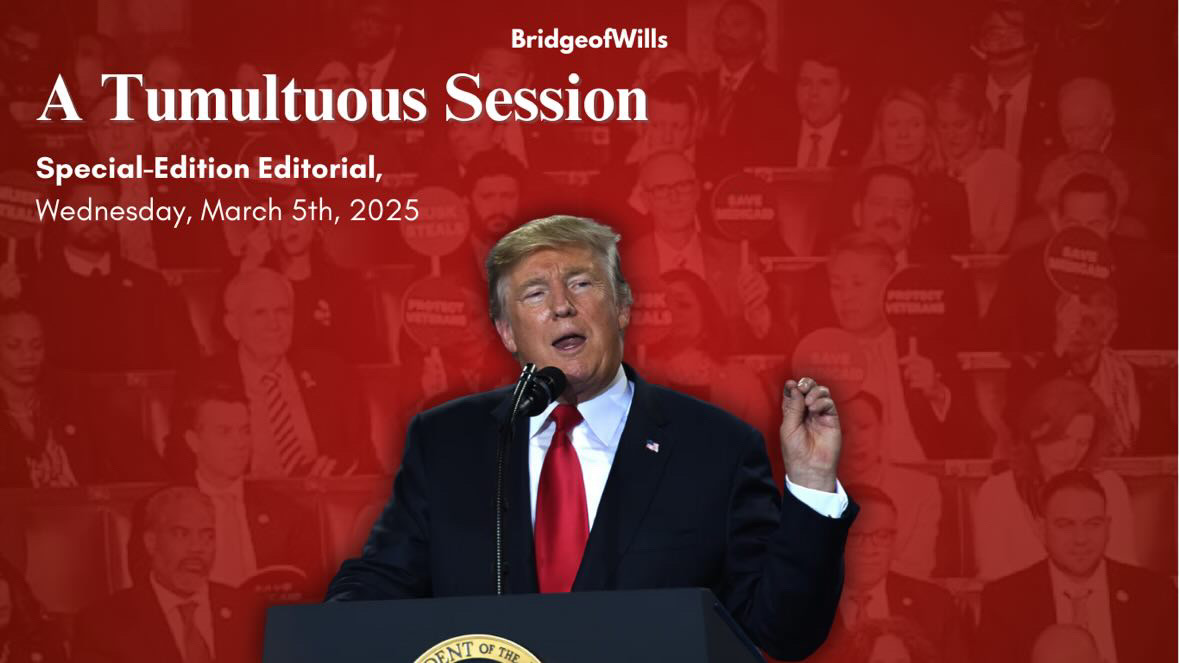
Republicans cheered, Democrats booed—the best description of President Trump’s joint address to a tumultuous joint session of Congress. During his record-long one-hour-forty-minute address, Trump touted administration victories that he likened to none other in America’s history and ambitiously claimed that his administration had delivered more in the last 44 days, even more than George Washington’s. Trump’s address was more akin to a campaign speech than a formal State of the Union, which this wasn’t, given the President is serving non-consecutive terms and has instead just named this an address to Congress as previous Presidents have done before in their first speech to Congress.
Trump ran through the gambit of his traditional talking points—from taking jabs at the Democrats in the audience to touting his tariff policy, applauding his successes, and blaming the previous administration for what he views as America’s disrepair, it just seemed like a typical Tuesday night for the President, but the conduct of those in the crowd made it a night to remember.
Trump’s Entrance
As members of government streamed into the gallery and their seats—from members of Trump’s cabinet to the justices on the Supreme Court, who weren’t all in attendance with members, Gorsuch, Sotomayor, Alito, Thomas, and Jackson chose to sit out. As anticipation grew, the bipartisan group that traditionally escorts the President into the House chambers entered as Trump strode to the podium—returning to Congress for the first time since his return, and Republicans stood with raucous elation. The chants of U.S.A filled the gallery and provided a stark rift to the silence displayed by Democrats.
Democrats, in their silence, held up circular signs criticizing Trump with messages including “False,” Musk Steals,” and Save Medicaid” to show their opposition. But as Trump strode in, Representative Melanie Stansbury of New Mexico held up a “This is NOT Normal” sign, which was quickly thrown aside by Representative Lance Gooden of Texas—finally, at 9:19 PM, Trump delivered his speech.
As Trump began and touted his electoral mandate, Representative Al Green of Texas started to heckle and shout, “You have no mandate.” The heckling turned more intense, and Speaker Mike Johnson had him escorted out for breaching decorum—Trump continued his speech, and though his intent at the beginning was perhaps to help unify America by wearing a purple tie symbolizing bipartisanship, he was to get none.

The Agenda and Rhetoric
Trump’s gambit in the speech crafted by lead speechwriter Ross Worthington was to set the administration’s goals in the month ahead; the goals were broadly organized into tax policy, global policy, D.O.G.E, the border, and education.
Trump began to roll out the hits, and just like his first term, he set tax reform as top on his priority list—Trump’s plan calls for making his 2017 cuts permanent, with no taxes on tips, overtime, or Social Security benefits. According to the Committee for a Responsible Federal Budget in a report created in October 2024, it is estimated Trump’s plan would add 7.75 trillion to the national deficit through FS Year 2025. Despite the reticent attitude of some more libertarian members of his caucus, Trump pushed ahead in his resolve.
In terms of global policy, Trump waved Zelenskyy’s letter written for him on Tuesday to help mend the hurt from last Friday’s disastrous meeting as an appropriate show of “attitude change” and hinted that the mineral deal struck would be signed in the following days. Trump softened the rhetoric he used against the Ukrainian President and called it a “beautiful thing” that Ukraine was
In other aspects, Trump defended his tariff policy and announced that reciprocal tariffs for friends and foes alike would hit on April 2nd without discrimination—this is despite the fact that markets have taken a serious tumble in their wake. Trump reiterated his conviction that Greenland would come to the United States “one way or another” without concrete facts as to how this process would take place.
D.O.G.E was another serious issue on the President’s mind, having only nice things to say about Elon Musk’s efforts in cutting the federal government—in a long tangent of his speech, Trump ran down all the things that D.O.G.E had cut, including debunked claims over trans mice, DEI (Diversity Equity and Inclusion) scholarships in other countries, and LBTQI programs in Africa. Democrats roared at the praise of Musk and balked at what Trump claimed DOGE was saving taxpayers.
He [Elon Musk] didn’t need this. He didn’t need this.
Donald Trump
The border was another one of his key issues during the speech—Trump flaunted border crossing levels that have recently reached 15-year record lows and the introduction of his new “gold card” to replace the EB-5 Visa. With this gold card, foreign nationals can pay their way into acquiring US citizenship by investing 5 million in America—Trump has cited dubious statistics as to how this “gold card” would pay down the national deficit, and legal scholars argue that he can’t introduce a new VISA system without an act of Congress.
To wrap up his signature policy goals, Trump cited Peyton McNaab, a volleyball player from North Carolina who suffered a traumatic brain injury playing against a trans-identifying player who spiked the ball and caused the damage. The President also threatened to pull any federal funding to any college or university that harbored these trans athletes on their teams and any who condoned “illegal protesting” that he claims “disrupts” the educational environment. Finally, after a speech rife with interruptions and standing ovations from the Republican side, Trump hailed the return of the common sense revolution and the beginning of the new American age that would characterize the core messaging of his new administration.


Elated Republicans, Dismissive Democrats
Democrats did not rise at all and only stood and clapped twice; one clap was for Trump’s assertion that the United States had sent billions of dollars in aid to Ukraine, and the other was Trump announcing the liberation of American citizens that were released in the last few weeks from the hands of the Russian government. Trump clearly was annoyed by the Democrat’s lack of clapping and proceeded to say that “nothing he could do” would ever make them rise and clap, not even him curing a disease that would “wipe out other countries” or announcing the greatest economy in history.
The Democrats’ reaction provides a glimpse as to what the 2026 midterm strategy will be: oppose Trump, give his claims little credence, and cast him as a person “under the control of Putin” and a usurper who will threaten to cut services like Medicaid and Social Security. If there was any hope for bipartisanship, it died in stone-faced silence against the Republican’s rapturous applause, and it makes it clear that this Trump term would see the same resistance by Democrats as the first term did.
The Democrats’ Response
Like a traditional State of the Union, a member of the opposition party is tasked with responding to what the President says; this member is usually a rising star within the party and one party leaders see a future in—this member was Elisa Slotkin for the Democrats. A former Representative narrowly elected to be Michigan’s new Senator on the same ballot as Kamala Harris, even as she lost Michigan to President Trump, promised to keep her response brief and concise. Against the backdrop of Trump’s almost two-hour-long speech, she delivered an 11-minute one laying out Democrats’ grievances and criticisms of the Trump administration.
Slotkin’s response was one of warning—she said Trump’s tariffs and policy could take us into a recession, a warning the Atlanta Federal Reserve has echoed. She criticized Trump’s policy that Democrats warn will alienate the United States from the global community and likened the scenes from Friday’s meeting to a “reality TV show.” She also shifted Democrats’ messaging to acknowledging their defeat in November, characterizing it as Americans clamoring for change. Still, she characterized the Trump/Musk government slashing change as dangerous and reckless and destroying the fabric of democracy and pleaded with voters to stay engaged in this difficult time.
The tumultuous session last night reaffirmed the stark partisan polarization that both sides have resorted to, and a look as to what’s to come over the remaining years of Trump’s second term.


Leave a Reply